80th Anniversary of the Passing of Henryk Sławik
“A hero of three nations – Polish, Jewish and Hungarian. There are only a few people who fully deserve such a description. It is no exaggeration to count Henryk Sławik amongst the noblest Poles in World War II who took the fight up to the Germans outside the borders of Poland and who helped Polish citizens, including Jews”, wrote Grzegorz Łubczyk, diplomat, Polish Ambassador to Hungary (1997–2001), researcher and promoter of Henryk Sławik’s story, author of his first biography (2003).
Henryk Sławik lived in exile since September 1939, arriving in Hungary from war-torn Poland. He became chairman of the Citizens’ Committee for the Care of Polish Refugees in Hungary, established in October, which mediated in cases between Polish refugees and the Hungarian authorities. He dealt with social welfare issues, schools, and medical care. Following the closure of the Polish Embassy in Budapest in January 1941, the Committee became treated as the representative of Poles in Hungary.
Among the refugees to whom Sławik and his associates extended aid, were Polish Jews who found themselves in Hungary. For the adults, Sławik made false documents and, for the children, he established an orphanage in Vác. Among those with whom he worked was Hungarian politician József Antall. It is hard to estimate just how many people they helped. Researchers estimate that it was between 5,000 and even up to 14,000 Jews.
Henryk Sławik was arrested by the Gestapo in July1944, after the Germans had already detained Antall. After being interrogated brutally, Sławik was transferred to the Gusen I (Mauthausen) concentration camp. He was hanged there on 23rd August 1944. Antall was released.
Read: The story of aid provided by Henryk Sławik →
For many years after the war, Sławik was forgotten. However, it was revealed by one of this hero’s associates, Henryk Zvi Zimmermann (1913–2006), a lawyer, diplomat and active in the Jewish underground during World War II. He was, later, an important figure in Israeli politics and was one of the witnesses in the trial of German war criminal Adolf Eichmann.
Henryk Sławik was posthumously honoured with the title of Righteous Among the Nations (1977) and awarded the Order of the White Eagle (2010). Since then, in Poland, there have been many memorials dedicated to Sławik and Antall, including in Katowice (2015), Warsaw (2016) and Budapest (2017). The two wartime associates also became patrons of the square in front of the “Spodek” Arena in Katowice (2014) and a boulevard in Budapest (2016). The Educational Centre of the Institute of National Remembrance in Katowice also bears his name.
Henryk Sławik in the POLIN Museum’s Photograph Collection
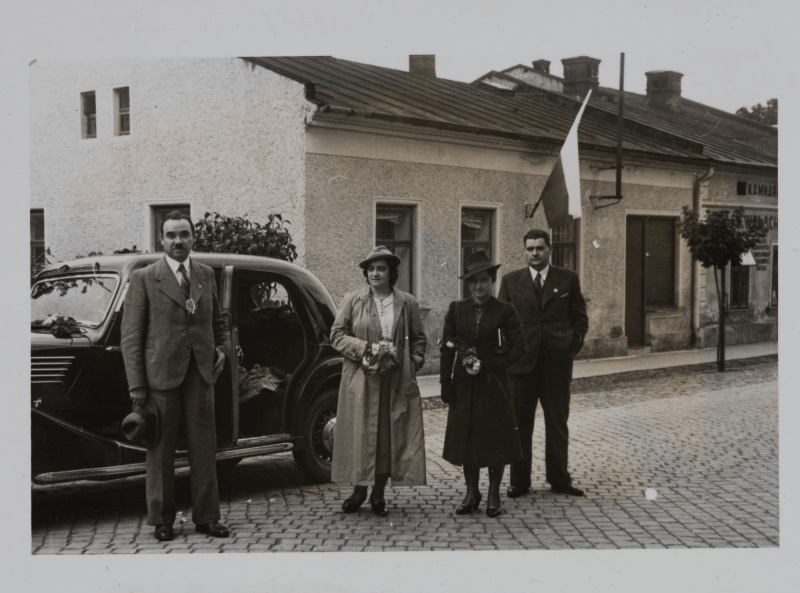
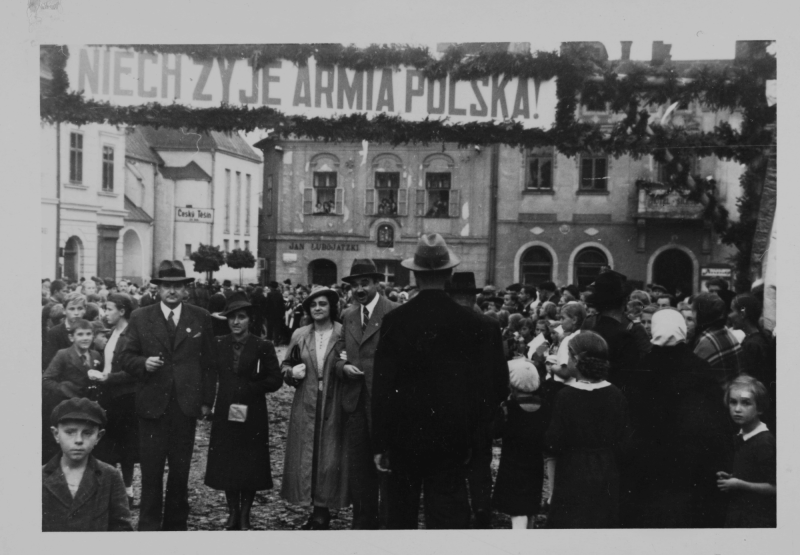
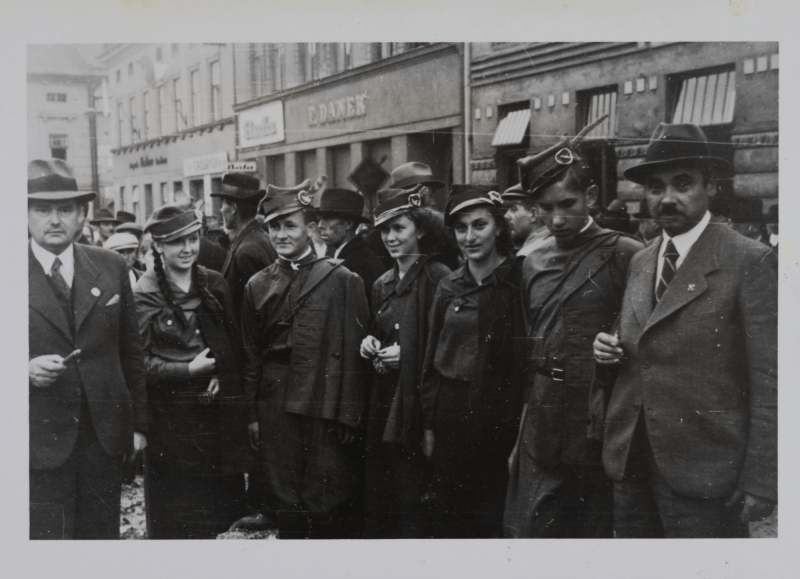
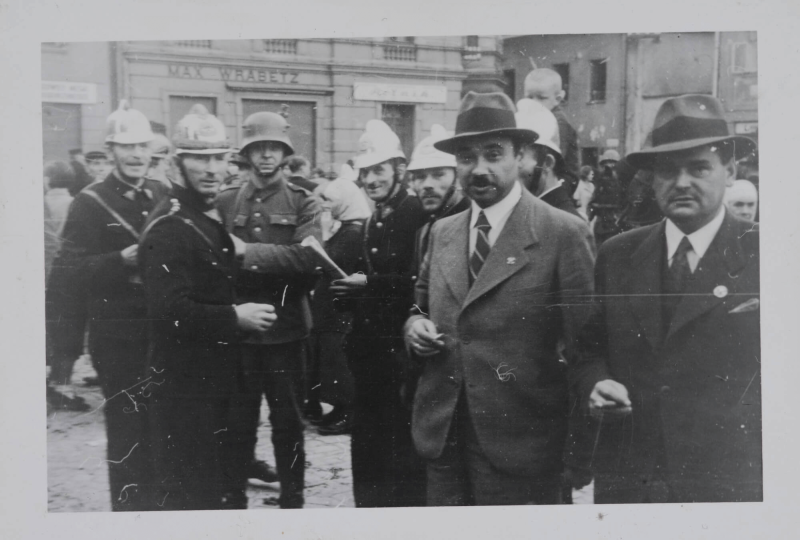
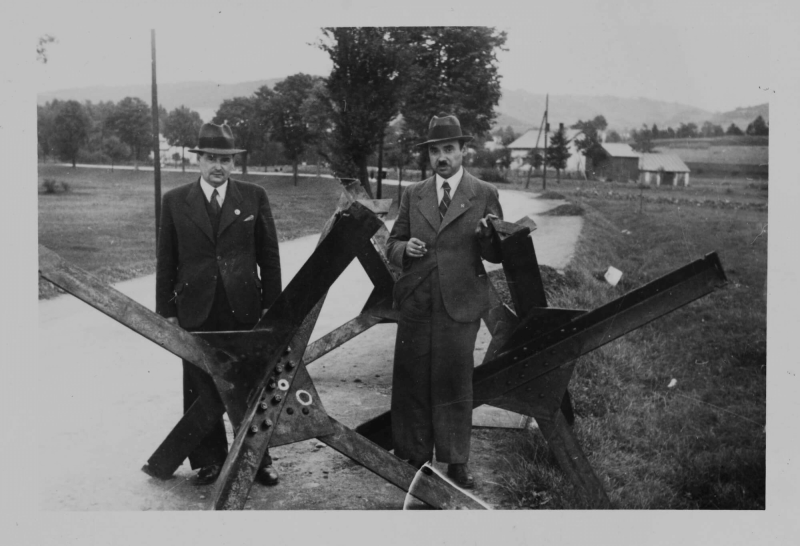
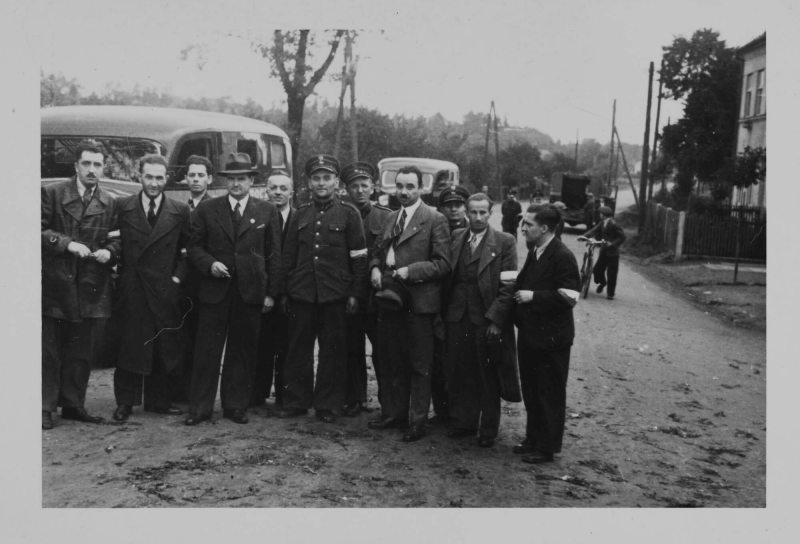
The POLIN Museum collection preserves two pages of a photo album with photographs of Henryk Sławik. There are eight photographs taken in 1938–1939. Six of them show Sławik taking part in celebrations of the Polish occupation of Czechoslovak Zaolzie in October 1938. The other show Sławik in the port of Gdynia and on board of the transatlantic liner MS Batory in 1939.
The circumstances in which the album, containing the photographs, was created are unknown, nor is the name of the photographer. The fact is that, on 2nd October 1938, Henryk Sławik, together with his wife Jadwiga, took part in a ceremony connected with the Polish Army’s entry in the Czechoslovak Zaolzie, taking part in a rally in the market square of Jabłonków (cz. Jablunkov).
The occupation of Zaolzie was the result of the Polish government’s ultimatum to the Czechoslovak government, in which Warsaw demanded the transfer of part of the Český Těšín and Fryštát counties to Poland. This was to have taken place after the Munich Conference (29th–30th September 1938) on the annexation of part of Czechoslovakia’s territory to the Third Reich. The day after the ultimatum was issued, on 2nd October, Polish soldiers, from the “Śląsk” Independent Operations Group, entered Zaolzie.
Dr Tomasz Kurpierz, author of the latest biography of Henryk Sławik, published, in 2020, by the Katowice branch of the Institute of National Remembrance, wrote:
“Especially in Śląsk Cieszyn, but also throughout the Śląsk Province and in the country, there was a euphoria and a sense of satisfaction, mixed with embarrassment felt by some people because of dramatic situation in the operation against the southern neighbour.”
“Of course, the Polish socialists supported the demands for the return of Zaolzie to Poland, but stated that it should be achieved the a voluntary and peaceful agreement between Warsaw and Prague, and pointed out that it could not be only an indirect result of Berlin’s aggressive moves. Immediately prior to the Munich Conference, on 24th September 1938, the PPS General Council adopted a resolution in which it emphasised that, regardless of the Czechoslovakia’s ultimate fate, the Third Reich would not abandon its policy of ‘constantly repeating its achievements’.”
“[...] Unfortunately, it is not known how Sławik saw these events – whether his enthusiasm prevailed after the occupation of Zaolzie or whether his view was more realistic. It is only known that, on 2nd October 1938, together with his wife Jadwiga and others, he took part in the ceremony welcoming the entry of Polish troops into Český Těšín [ed: the photographs show the market square Jabłonków.]”.
For the first time, on the Polish Righteous portal, we publish six photographs from the POLIN Museum collection showing Henryk Sławik in Zaolzie. The photographs appear at the top of this page.
Read and view more:
- The story of Henryk Sławik [a story of aid] →
- The Righteous in Hungary [a thematic study] →
- Poles murdered for helping Jews [stories of aid] →
- The attitude of Poles towards Jews during the Holocaust [a thematic study] →
- The death penalty for helping Jews in occupied Poland [a thematic study] →
- Jews hiding on the “Aryan side” [a thematic tab] →
- Jews helping other Jews on the “Aryan side” [a thematic tab] →
- A catalogue of educational and expert material: “In Hiding – Stories of Survivors and the Righteous” →
- Educational film and discussion with experts about Irena Sendler and Jadwiga Piotrowska →
- Educational film and discussion with experts about Jan and Antonina Żabiński →
- Interviews from the POLIN Museum’s Oral History Collection [YouTube channel] →