World Photography Day

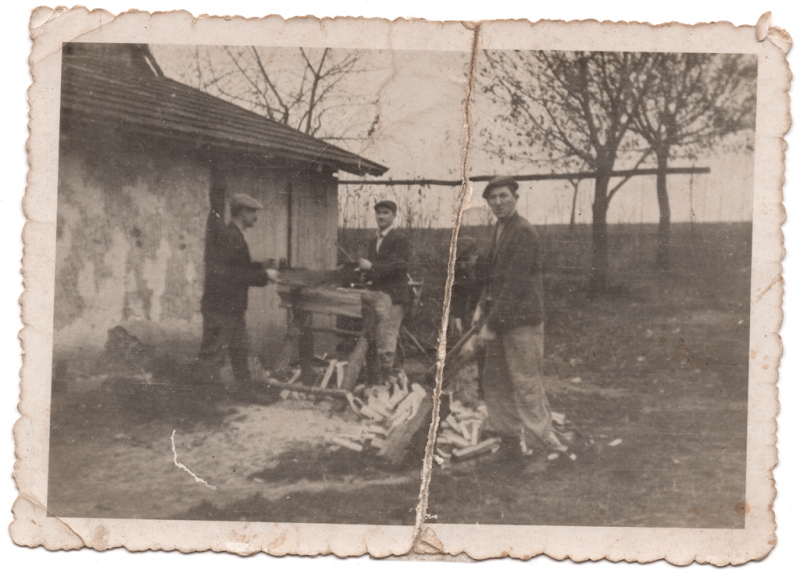

“Photography is not merely the result of a photographer’s encounter with an event. Taking photographs, in itself, is an event, only that is opening privileged”, wrote Susan Sontag in the collection of essays entitled “On Photography”. “The event will pass, but the photograph will remain, providing the recorded event a kind of immortality and meaning, which it would be deprived of without the photograph. While real people kill real people or themselves, the photographer hides behind the camera and created a tiny fragment of another world – a world of images which proclaims loudly that it will outlive us all”.
Photographs from POLIN Museum collection
Photographs comprise an important part of the POLIN Museum collection. Preserved in the Museum’s digital repository are 70,000 photographs documenting heritage material and 362,000 digitised archival photographs. Some of this collection (10,000 items) are displayed on this Polish Righteous portal.
The photographs presented are primarily those, obtained since 2007, from family archives – from people honoured with the title of Righteous Among the Nations as well as from Holocaust survivors and their descendants.
In the collection of contemporary iconography, in addition photographs documenting heritage material (e.g. preserved Jewish hideouts on the “Aryan side”), the collection of portrait photographs of witnesses to history deserves special attention. These are photographs showing the last living Righteous and were taken by outstanding photographers including Anna Liminowicz, winner of Krzysztof Miller Award (2018) and the Grand Press Photo (2014 and 2016).
A separate collection comprises photographs from other institutions, including the Yad Vashem Institute in Jerusalem, the United States Holocaust Memorial Museum in Washington, the Jewish Historical Institute in Warsaw and the Institute of National Remembrance. We thank these institutions for permitting us to make these photographs available to a wider audience.
Photographs from the Polish Righteous Portal
To mark World Photography Day, we have selected ten photographs from POLIN Museum’s collection, as well as five photographs from the collections of other institutions. The photographs are presented, on this page, in the photograph gallery above and are described, in detail, below.
Selected Photographs from POLIN Museum Collection:
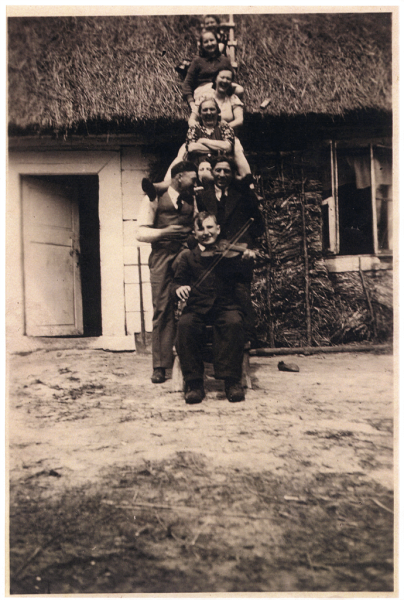
The Gawrych family, in front of their house, with the Jews they were hiding, Wólka Czarnińska, before 18/03/1943. Photo: POLIN Museum Digital Collection
Photographs, showing Jews in hiding in occupied Poland, are rare – photographs were not taken of this experience which was to remain strictly secret. However, this does not mean that no such photographs were ever taken, as evidenced by the preserved photograph from Jadwiga Gawrych’s family archive. This photograph is also exceptional for another reason – on 18th March 1943, the Germans conducted a search of the Gawrych house, the result of which was the murder of the Polish family and the Jews who were hiding with their help. For more photographs see: The story of the rescue provided by the Gawrych family →
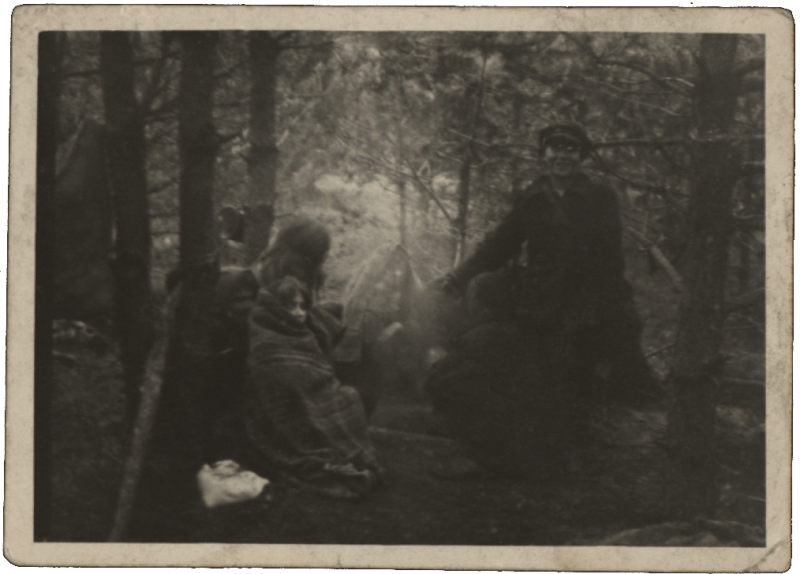
Jews hiding in the forest, Unin near Garwolin, 10/01/1943. Photo: POLIN Museum Digital Collection
Hiding in a forest, for a prolonged period, was one of the most difficult experienced for Jews on the “Aryan side”. This is why one of the least documented images of that time deserves special attention – Jews, by a fire, hiding in a forest. The photograph is part of POLIN Museum’s Permanent Exhibition. See a few similar photographs: Jews in hiding in the countryside →
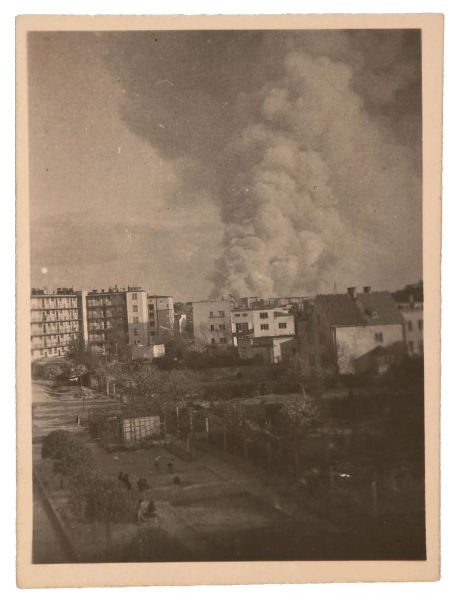
A smoke cloud over Warsaw during the Ghetto Uprising (view from the “Aryan side”), Warsaw, April 1943. Photo: POLIN Museum Digital Collection
This photograph was taken by 22-year-old Bogdan Wójcik during an Easter breakfasat on 25th or 26th April1943, from a balcony at ul. Mickiewicza 25 in Żoliborz. At that time, those present in the apartment were Maria Wójcik, her son Edward, his daughter Maria, his son Bogdan, as well as Edward;s sister, Janina Stupnicka and her daughter Anną – and, hidden with their help, Liliana Alter (at the time known as “Krystyna Wójcik”). Read the story of the rescue provided by the Stupnicki family →
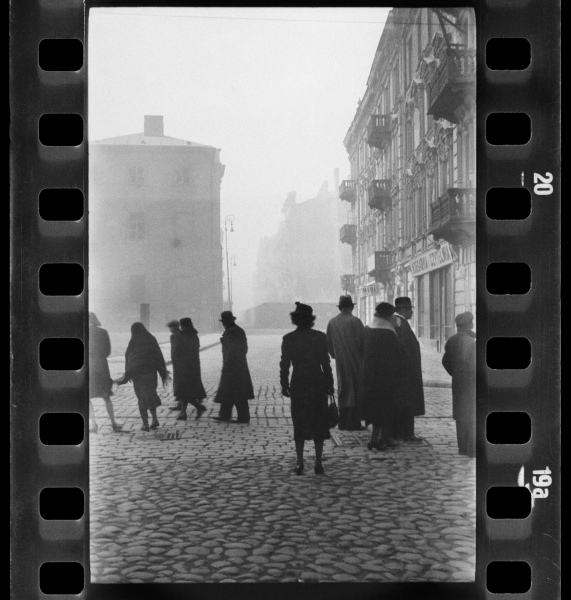
Poles watching the burning Warsaw Ghetto during the Uprising, Warszawa, April–May 1943. Photo: Rudolf Damec / POLIN Museum Collection
Warsaw resident near the Ghetto wall (visible in the background) at the corner of ul. Świętojerska and ul. Bonifraterska and pl. Krasińskich. Some of the people are looking towards the burning ghetto, others are looking away. See the series of Rudolf Damec’s photographs: Unique photographs showing witnesses to the Warsaw Ghetto Uprising →
Discovery of the “Krysia” bunker, Warsaw, 1945. Photo: POLIN Museum Digital Collection
This hiding place, organised by the Wolski family, was one of the largest and best organised in occupied Warsaw – about forty people hid there. Among them was historian Emanuel Ringelblum. On 7th March 1944, as the result of a denunciation, officers of the German gendarmeries, with the suppoty of “blue policemen”, discovered the hideout. A few days later, all the Jews hiding there, as well as their two Polish guardians, were shot by the Germans on the ruins of the ghetto. See the scent of the unearthed hideout after the war: The story of rescue provided by the Wolski family →
Pola Najder-Gałkiewicz and Andrzej Śliwiak, Świnoujście, 1975. Photo: Tomasz Najder / POLIN Museum Collection
In the summer of 1975, Tomasz Najder accompanied his mother, Pola Najder-Gałkiewicz, to a special meeting with Andrzej Śliwiak, who a few years later was awarded the title of Righteous Among the Nations. He captured their shared moments in Świnoujście, filled with emotion and gestures of kindness, in more than a dozen photographs. These include a walk on the Baltic Sea beach. Over 30 years earlier, Andrzej Śliwiak had helped Pola and her husband, Marcel Najder, by providing them with shelter during the extermination of Jews in Kołomyja. From December 1942 to March 1944, Śliwiak hid a total of ten Jews in a specially prepared hiding place on the outskirts of the city, which was then occupied by the Germans. A remarkable memento from this period has survived – a chestnut chess set made by Pola Najder in the hiding place. Her son donated this item to POLIN Museum collection.
The story of rescue provided by Andrzej Śliwiak →
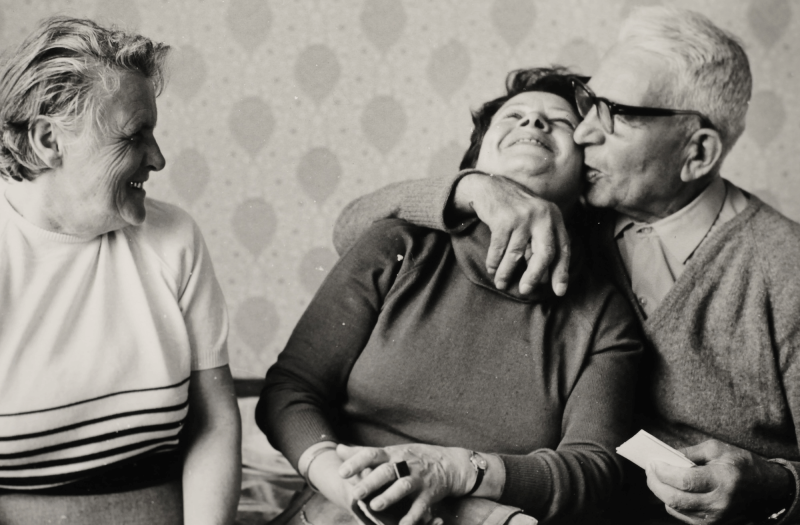
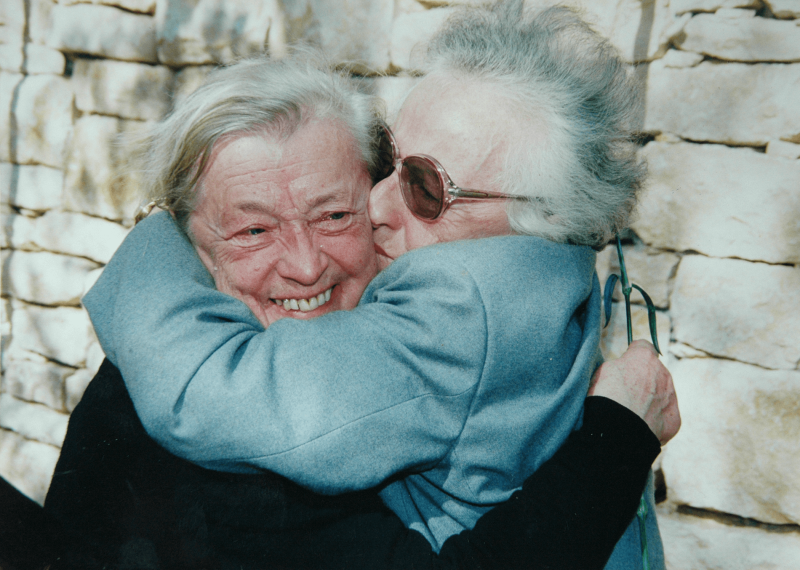
Antonina Siwek and Rywka Holender, Jerusalem, circa 1983. Phot. Antonina Siwek family archive / POLIN Museum Collection
Two women – a Righteous Among the Nations (on the left) with a Holocaust Survivor (on the right), in a warm embrace in the Garden of the Righteous. This was their first meeting after many years of correspondence. The story of rescue provided by Antonina Siwek →
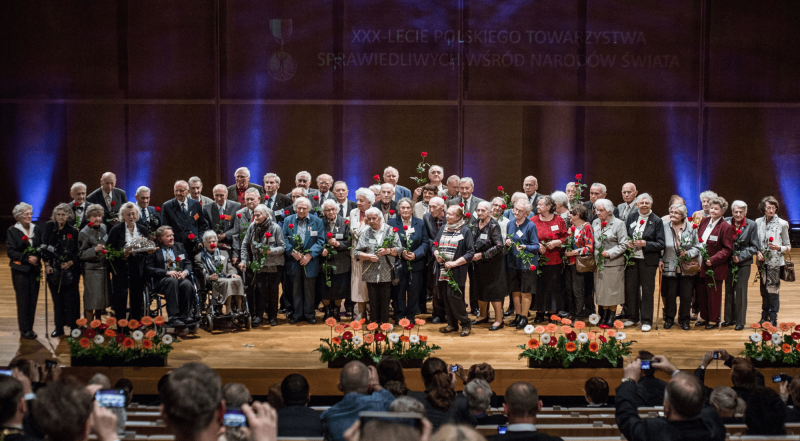
Righteous Among the Nations during the 30th Anniversary Gala of the Polish Association of the Righteous Among the Nations, Warsaw, 16/10/2016. Phot. Magda Starowiejska / POLIN Museum Collection
This is the onlygroup photograph (several shots were taken) showing, in one place, so many Polish men and women honoured with the title of Righteous Among the Nations.The event, organised by POLIN Museum was the first and only meeting, of this type, of Righteous from all over Poland. See other photographs documenting this event: 30th Anniversary of the Polish Association of the Righteous Among the Nations →
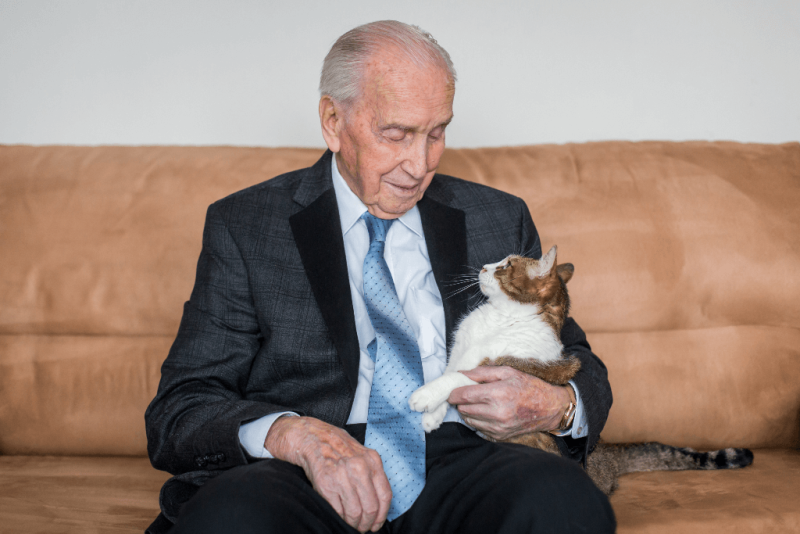
Józef Walaszczyk, in his apartment, with his cat, Warsaw, 15/02/2019. Photo: Anna Liminowicz / POLIN Museum Collection
This is one of our favourite photographic sessions with one of the last living Righteous Among the Nations. See more photographs by Anna Liminowicz: The story of rescue provided by Józef Walaszczyk →
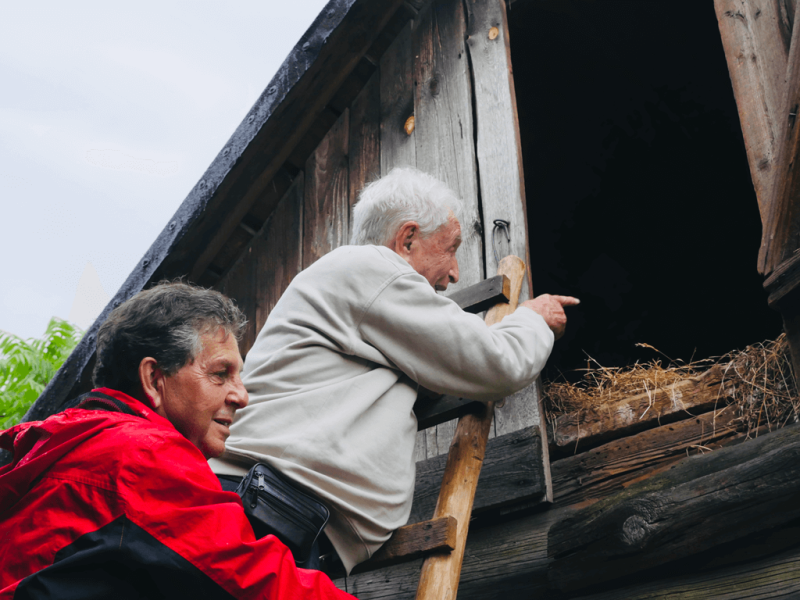
Jakub Berkman shows where he hid during the Holocaust, Suchedniów, 30/08/2019. Phot: Mateusz Szczepaniak / POLIN Museum Collection
This photograph is part of the documentation of Jakub Berkman’s visit to Poland. Jakub Berkman is standing on a ladder in front of the entrance to Leopold von Krauze’s attic, where he hid, with his parents, during the Holocaust. This was his first visit to this place since he had left the hideout. See more photographs documenting this visit: The story of Jakub Berkman’s survival →
Iconic photographs from the collections of other institutions:
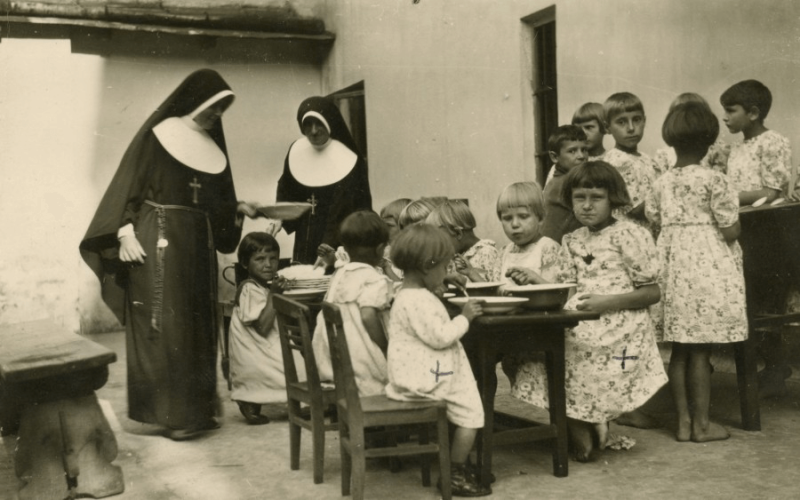
Polish and Jewish children in an orphanage, run by the Congregation of the Franciscan Sisters of the Family of Mary, Lwów, Circa 1941. Photo: Archive of the Congregation
The collections of many institutions contain quite a number of photographs of Jewish children hiding in orphanages run by Roman Catholic nuns. What is special about this photograph is the fact that the Jewish children are marked with a “+” sign. See similar photographs: The story of the rescue provided by Matylda Getter →
The Goldman family while in hiding with the Ulma family, Markowa, before 24/03/1944. Photo: Józef Ulma / the Digital Collection of the Ulma Family Museum of Poles Rescuing Jews During WWII
Józef Ulma’s greatest passion was photography. Initially, he used a self-assembled camera. However, over time, he began using professional equipment. To this day – despite the tragic fate of the Ulma family – a large collections of photographs, documenting the Ulma family’s life, has been preserved. Of particular interest, among them, is a photograph showing the Jews in hiding, who died on 24th March 1944, together with the Ulma family. See more of Józef Ulma’s photographs: The story of rescue provided by the Ulma family →
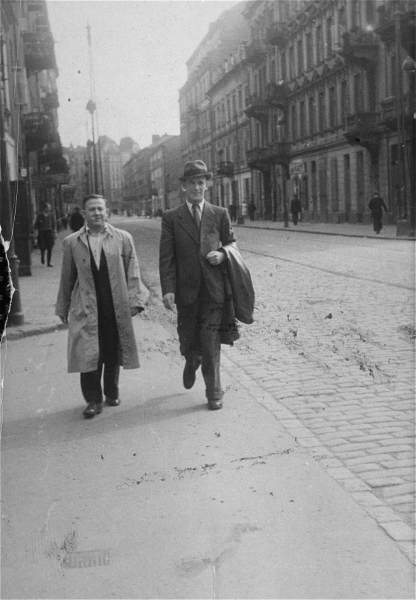
Going to a hiding place on the “Aryan side”, Warsaw, 01/05/1943. Photo: United States Holocaust Memorial Museum
An absolutely extraordinary and unique scene – Stefan (Szlomo) Grajek, a member of the Jewish resistance movement, leads Tuwia Borzykowski to a new hiding place. The men are walking along ul. Twarda, by ul. Śliska, the view looking towards the south. See more photographs from the “Aryan side” of occupied Warsaw: Jews hiding in cities →
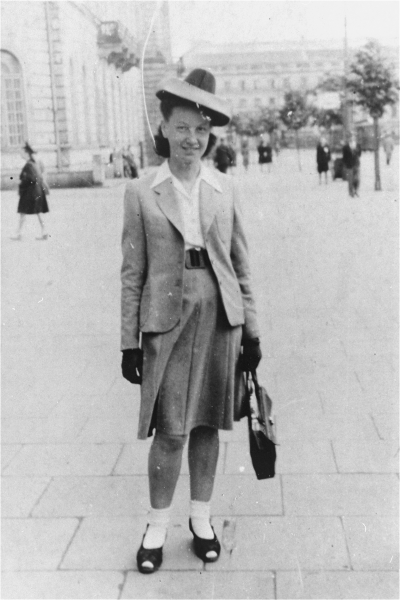
Fajga Peltel-Międzyrzecka (Władka Meed) on the “Aryan side”, Warsaw 1944. Photo: United States Holocaust Memorial Museum
Jews in occupied Poland would hide “under the surface”, namely they remained physically hidden in a hiding place, but also “on the surface”. functioning openly using, among other things, false identity papers. The second strategy for survival was chosen by Fajga Peltel-Międzyrzecka, a leading figure in the Jewish resistance movement in occupied Warsaw. The photograph show her walking around plac Teatralny, in an elegant outfit and hat. See more similar photographs: The story of Fajga Peltel-Międzyrzecka →
Abram Grinbaum and Helena Garbarek in hiding, Niedzieliska near Gąbina, 1945. Photo: Emanuel Ringelblum Jewish Historical Institute in Warsaw
It is hard to find a more symbolic photograph depicting the experience of Jews in hiding on occupied Poland – two people, probably in a barn. A man looks out from between the boards of a haystack. A woman kneels in front of him with a pot. However, this is just a post-war staging of hiding. See what hiding places looked like: Jewish Hiding Places on the “Aryan side” →
See and read more:
- Recommended stories – the ten most famous Polish Righteous Among the Nations [catalogue of stories of rescue] →
- Members of the “Żegota” Council to Aid Jews [catalogue of stories of rescue] →
- The story of Irena Sendler and her co-workers [a story of aid] →
- The House Under a Wacky Star. The story of rescue provided by Jan and Antonina Żabiński [a story of aid] →
- The attitude of Poles towards Jews during the Holocaust [thematic study] →
- The death penalty for helping Jews in occupied Poland [thematic study] →
- Poles towards Warsaw Ghetto Uprising [thematic study] →
- Jews hiding on the “Aryan side” [thematic study] →
- Jews helping other Jews on the “Aryan side” [thematic study] →
- Interviews from POLIN Museum’s oral history collection [YouTube channel] →