Unique Photographs Showing Witnesses to the Warsaw Ghetto Uprising
As part of the commemorations of the 80th anniversary of the Warsaw Ghetto Uprising, the POLIN Museum of the History of Polish Jews has announced a year-long program – “Do Not Be Indifferent”. A temporary exhibition, the Daffodil Campaign, academic conferences and numerous educational workshops – these are only part of the program for 2023. On our Polish Righteous portal, we plan to publish new academic articles regarding the attitudes of Poles towards the uprising in the ghetto, which was taking place in front of their eyes. This article is about the unique photographs of Rudolf Damec, which show witnesses to the tragedy of the April 1943 tragedy. Their movements, gestures and facial expressions of the people encourage interpretation and discussions regarding the attitudes of Poles towards the extermination of the Jews.
Table of Contents:
- 27 photographs of the Warsaw ghetto during the uprising – Rudolf Damec's photographs taken in April 1943
- Rudolf Damec (1909–1969) – engineer, mountain climber, photographer – a biography of the photographer who took the pictures of the burning ghetto
- Poles looking at the ghetto – their movements, gestures and facial expressions of the people in Rudolf Damec's photographs – interpretations
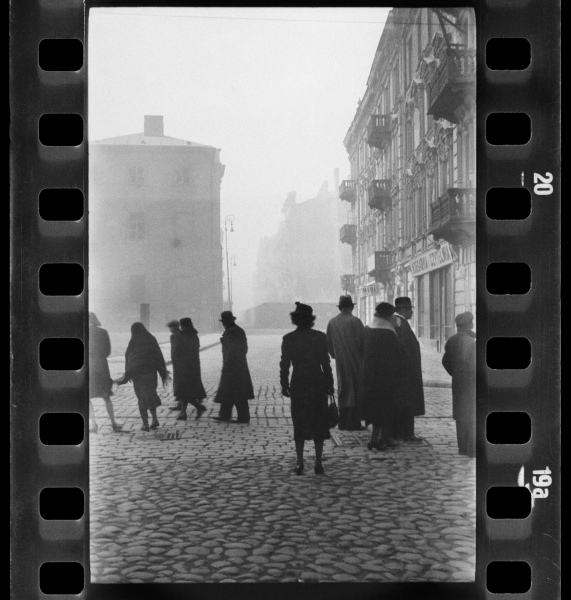
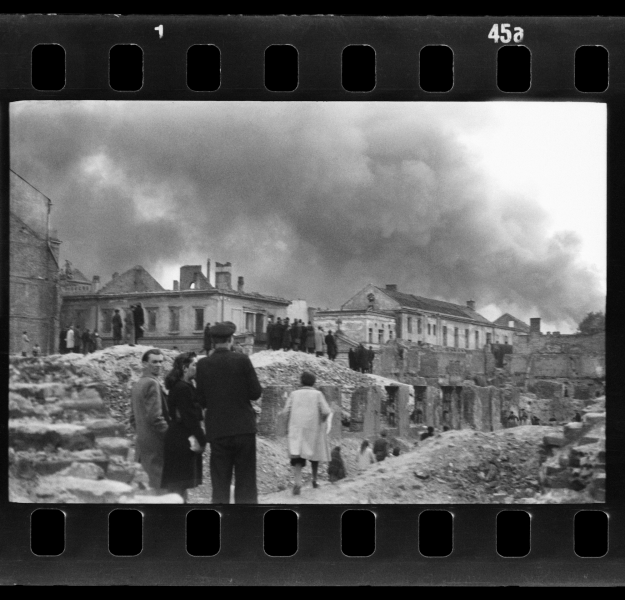
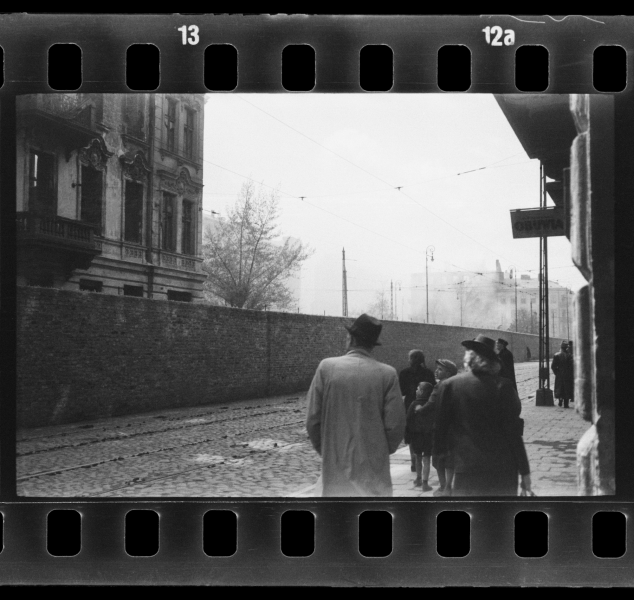
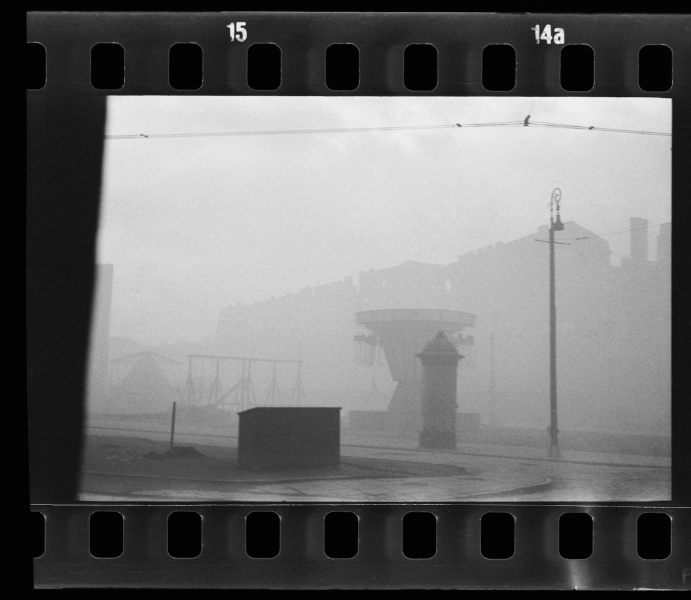
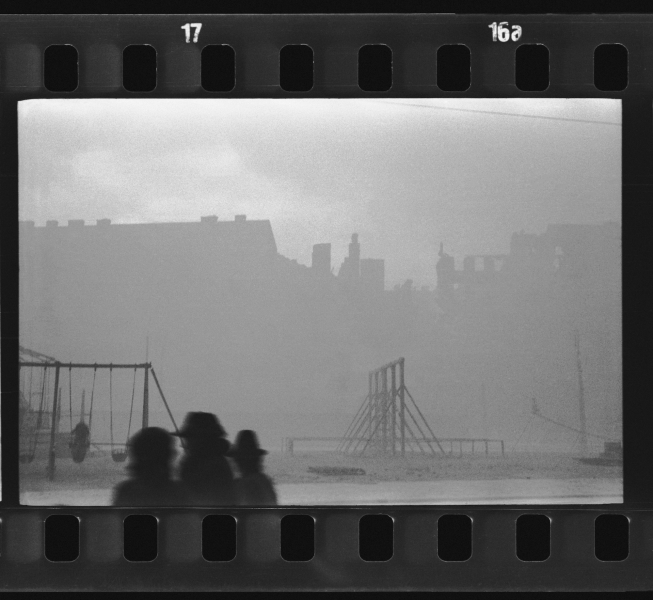
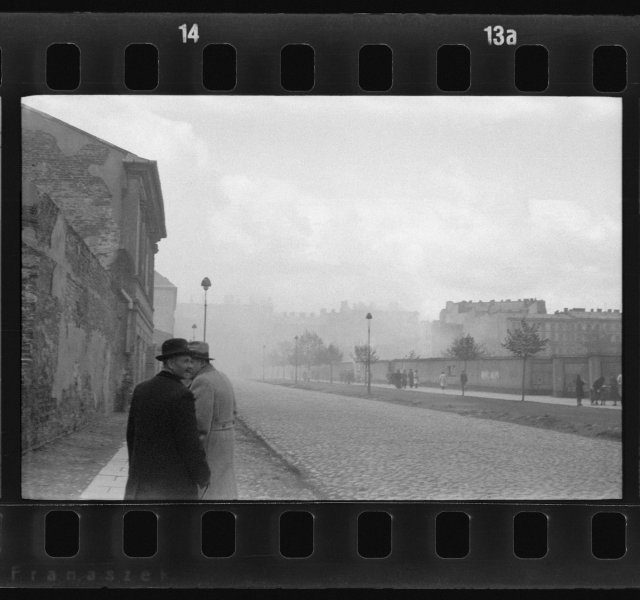
The photographs show the streets of Warsaw, ruins and flames over the ghetto. In one of the shots, a dozen or so people have climbed over a pile of bricks and are looking at the ghetto.
Rudolf Damec’s photographs were discovered, in 2019, by his granddaughter Aleksandra Sobiecka. In January 2023, she brought them to the POLIN Museum. From 18th April 2023, they will be displayed in our temporary exhibition “Around Us a Sea of Fire”, marking the 80th anniversary of the Ghetto Uprising.
It began with a search for women. Since 2017, Aleksandra Sobiecka has been documenting the fate of her family. She wished to reconstruct the biography of her great-grandmother Maria Konopnicka, true to its name, a family related to the famous Polish poet. In 2019, she visited her uncle in Gdynia. He told her to look at the photographs in the family home, now belonging to her father – “because the ghetto is there”.
Aleksandra was surprised, “What ghetto?”.
She returned to her sisters, who had boxes of photographs, which she had looked at before.
“The photographs had been developed in a very small format. I hadn't looked at all of them. I was looking for my great-grandmother in them. I look. Indeed, there is one more box and it contains negatives. I took them and began looking through them.”
27 Photographs of the Warsaw Ghetto During the Uprising – Rudolf Damec’s Negatives from April 1943
There were negatives in envelopes and envelopes – and also slides. For her birthday, her husband and son bought her scanner. Gradually, she began scanning the negatives. “I really needed to see them all”, she says.
Those showing the burning Warsaw Ghetto were rolled up tightly. Meticulously, Aleksandra straightened them, cut them into sections of six frames, placed them inside shirts and put them under books in order to straight them.
“These photographs made a huge impression on me – those taken from behind the ghetto wall. I looked through them and put them back to straighten them.”
“The wall is in full view, so that it was obvious that these photographs were taken from the side of the city where there was no ghetto, towards the side where the ghetto was located.”
The photographs were taken by Aleksandra’s grandfather, Rudolf Damec, probably using a Kodak Retina camera.
In 1943, with his family, he lived on Grzybowska Street and was a warehouse worker at the Polish Optical Works in Grochów.
On the same negatives, there are portraits of his family – wife Ewa, with braid tied around her head, as well as her younger siblings Witek and Jola. There is Ewa and Rudolf’s daughter, Xenia, in a white sweater. Rudolf, himself, also appears, reclining in a clearing in a forest, holding his son Zbyszek, Aleksandra’s future father, then two-years-old. A fair-haired boy gives Rudolf a cone. All these are next to photos of burning buildings, rubble with clouds of smoke above them. There is an empty playground, with smoke haze.
“I immediately thought of Czesław Miłosz’s poem 'Campo di Fiori’, the carousel on Krasiński Square, standing behind the wall”, says Aleksandra.
She showed the photographs to her husband, who supports her in her historical research. He, himself, was writing his master’s thesis on the history of the Polish People’s Republic and was very interested in the events of March 1968.
Aleksandra recalls that the topic of Jewish history was not present in her family and, in school, it was presented sparingly. She had kept her history book from 1986. It already contained notes on topics which were omitted, passed over in silence and even were forbidden in the People’s Republic of Poland – the extermination of Jews and Katyń. However, later, she became fully aware of the fate of Polish Jews.
Rudolf Damec (1909–1969) – engineer, mountain climber, photographer – author of the pictures of the burning ghetto during the uprising
The reconstruction of the wartime fate of her family would not have been possible without the help of her cousin from France. In 2019, the same year when she discovered the photographs of the burning ghetto, he came to her with a flash drive full of family documents.
“He told me that he would leave it with me, because it didn’t tell him much. All of a sudden, I had all the documents, letters and biographies of my grandfather. Since then, I began learning about his history”, Aleksandra says.
After the war, Rudolf's wife, Ewa Damec, Aleksandra’s grandmother, was arrested for unknown reasons. In order to free her and to clear her of any possible charge of “fascist beliefs”, Rudolf wrote a letter to the Ministry of Security in which he told the story of how, during the war, he and his wife Helena Ronin had helped the Polish Jews.
Eventually, Ewa Damec was released from prison, thanks to the help of writer Zofia Nałkowska, among others.
Helena Ronin survived the war, emigrated to the USA and maintained friendly contact with Rudolf until his death. At her request, Rudolf was to bring a painting of birch trees [very popular in Poland] to Los Angeles – Helena liked birches very much.
“In our family, hardly anyone was born in the same place in which they died.”
Rudolf Damec was born, in 1909, in Dziećmorowice in Śląsk Cieszyński. He died on 11th May 1969 in a car accident in Ghana. He was in a hired taxi and wanted to see the Volta Dam in Akosombo. It occurred exactly on Aleksandra’s second birthday, which she celebrated in Warsaw. She never had the chance to meet her grandfather. He was an engineer by education, a mountaineer, a photographer and a traveller.
By profession, she dealt with public procurement and corporate insurance. She loves history and genealogy. She studied pedagogy, risk management and philosophy. Since the age of twelve, she has been photographing and documenting evets that are important to her.
Granddaughter and grandfather, intergenerationally and spiritually, share a common passion – a cognitive passion, for which he eventually paid the ultimate price.
Helena Ronin’s letter to Ewa Damec has been preserved in the family documents:
“Dear Ewa, I wanted to reply to your letter today because, yesterday, I learned of Rudolf’s tragic death. I don’t want to believe it – such a monstrous, absurd accident.”
“He has such a passion for travel and, for this passion, he paid with his life. It could have happened anywhere else, but I can’t help feeling that this was destiny. […] I had an extraordinary attachment to and friendship with him for what he did for us and, of course, you – I can never repay you with anything.”
Poles looking at the ghetto – the movements, gestures and facial expressions of the people in Rudolf Damec’s photographs – interpretations
Aleksandra Sobiecka showed the photographs, of the burning ghetto and of passers-by looking at it, to the writer and photographer Mikołaj Grynberg, who told Joanna Fikus, POLIN Museum’s Exhibition Department Director who, at the time, was working on a temporary exhibition to mark the 80th anniversary of the Warsaw Ghetto Uprising.
“This was a man, walking along the eastern border of the ghetto and taking pictures. We know that he was a deeply empathetic person. He had hidden a Jewish woman in his apartment and, at the same time, was so deeply moved by what he saw that he felt the need to document it. It’s a little like the story of a Righteous who, not only does something important, but also documents it”, says Joanna Fikus.
There are very few photographs which show the burning ghetto during the Uprising and of witnesses watching it. The POLIN Museum collection includes two colour slides by Zbigniew Borowczyk, which are displayed in the “Holocaust Gallery” of the Museum’s permanent exhibition.
The very topic of observers of the Ghetto Uprising is primarily present in literature of various kinds – fiction, personal documentaries, essays and in Jerzy Andrzejewski’s Wielki Tydzień, Czesław Miłosz’s poem Campo di Fiori, the diaries of Jarosław Iwaszkiewicz and in Jan Błoński’s essay Poor Poles Looking at the Ghetto.
The movements, gestures and facial expressions of the people in Rudolf Damec’s photographs lead to interpretation. They evoke numerous discussions about the attitudes of Poles towards the extermination of the Jews.
“The photographs are not posed. In one picture, you can see that the people are not even looking at the ghetto. In other shots, they seem to be frozen, standing in the middle of the street or across the footpath, staring directly at the wall. Children can be seen who, as children do, have minimal hesitation and shame – they are looking straight at the wall”, Joanna Fikus describing the individual photographs.
Aleksandra Sobiecka comments, “If not for the place and situation in which they find themselves, these people are almost artistic, theatrical”.
* * *
In 2023, POLIN Museum has organised a year-long program – “Do Not Be Indifferent – the 80th Anniversary of the Warsaw Ghetto Uprising”. The program’s key element is the opening of the temporary exhibition “Around Us a Sea of Fire – the Fate of Jewish Civilians in the Warsaw Ghetto Uprising”. The author of the exhibition'’s concept is Prof. Barbara Engelking, Director of the the Centre for Holocaust Research of IFiS PAN and the curator is Zuzanna Schnepf-Kołacz of the POLIN Museum of the History of Polish Jews. The co-organisers of the exhibition are the Association of the Jewish Historical Institute in Poland and the Centre for Holocaust Research.
Interviews, text: Joanna Król-Komła, ed: Mateusz Szczepaniak
English translation: Andrew Rajcher
March 2023
Read more:
- Poles’ reaction to the Uprising in the Warsaw Ghetto (ed. Barbara Engelking)
- Relations of witnesses to the Warsaw Ghetto from the collection of the POLIN Museum
- History of Andrzeja and Czesław Miłosz, witnesses to the Warsaw Ghetto Uprising
- POLIN Museum’s annual program: “Don’t be indifferent. 80th Anniversary of the Warsaw Ghetto Uprising”.
- Temporary exhibition: “Around Us a Sea of Fire – the Fate of Jewish Civilians in the Warsaw Ghetto Uprising”