March 6th is the European Day of Righteous.
This day was established in 2012, by the European Parliament, to honour individuals who, in the 20th century, risked their lives to oppose totalitarian regimes. The idea refers to the title "Righteous Among the Nations", awarded since 1963 by the State of Israel, expanding the concept of the “Righteous” and giving it a universal dimension.
Following the adoption of this resolution, local "Gardens of the Righteous", together with committees awarding this title, were established in many countries (including Armenia, Bosnia, Rwanda, Italy, and France).
The first, and so far the only, Garden of the Righteous in Poland was created in 2014 in Warsaw, in Gen. Jerzy “Jur” Gorzechowski Square in the Muranów district, next to the POLIN Museum of the History of Polish Jews.
Today we learned the names of the next individuals who will be honoured there.
Each year, on the European Day of the Righteous, observed on March 6th, the Committee of the Garden of the Righteous Foundation announces the names of individuals, who have demonstrated a noble deed in their lives.
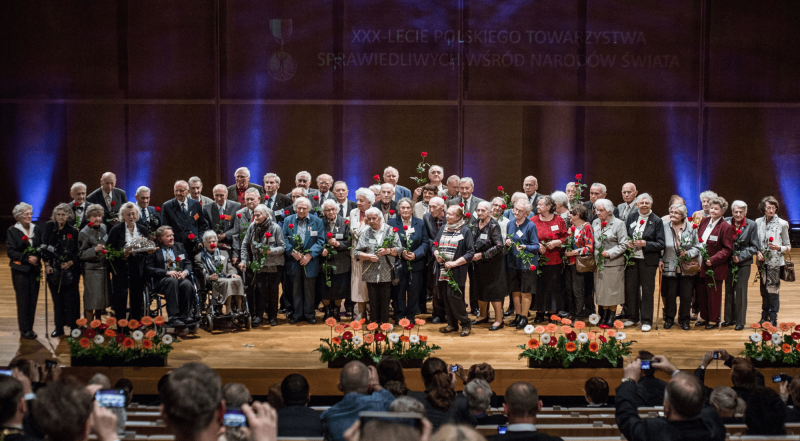
These individuals are honoured in the Garden of the Righteous in Warsaw - trees are planted in their honour and commemorative stones are unveiled. The annual ceremonies, honouring new Righteous, provide an opportunity to recall and present their stories, as well as to promote human rights education.
The Committee of the Garden of the Righteous Foundation, which selects those to be honoured with the title of "Righteous", consists of distinguished figures from the worlds of culture, scholarship and education, as well as representatives of non-governmental organizations.
Anyone may submit a nomination by sending their proposal to the Garden of the Righteous Foundation.
What does the title "Righteous" mean?
This concept has a universal character and serves to honour all individuals who, in Europe and beyond, have saved human lives or stood up in defence of human dignity and freedom - under totalitarian regimes, during genocides, mass killings and crimes against humanity committed in the 20th and 21st centuries.
It is a broader concept than the title of "Righteous Among the Nations", awarded by the Yad Vashem Institute in Jerusalem - an honorary distinction awarded by the State of Israel to non-Jews, in recognition of them helping Jews during the Second World War.
Who are this year's "Righteous"?
On 6th March, during the European Day of the Righteous, the names of the individuals who, by decision of the Committee of the Garden of the Righteous Foundation, were honoured this year with the titles of “Righteous”: Khosrow Alikordi, Dimitar Peshev and Frozan Safi.
We present their biographies below:
Khosrow Alikordi (1979–2025)
An Iranian lawyer and human rights defender, known for his uncompromising defence of political prisoners, protesters and the families of victims of state repression.
He gained particular prominence following the death of Mahsa Amini, when he represented individuals involved in the “Woman, Life, Freedom” movement.
For his activities, he has been repeatedly persecuted by the Islamic Republic of Iran authorities. He has been sentenced to prison terms, subjected to internal exile and has been banned from practising law and from any public activity.
He began his legal career in 2009, defending protesters following the events connected with the Iranian Green Movement. His involvement had serious consequences for his academic career.
Although, in 2010, he was admitted to a public law master’s program at the Allameh Tabataba’i University, he was placed on a “blacklist” and banned from any possibility of continuing his studies there.
He continued his education at the Islamic Azad University in Tehran. However, later, after serving a prison sentence, he was also expelled from his doctoral studies and permanently excluded from pursuing an academic career.
As a lawyer, he handled many cases of great symbolic significance, particularly in Khorasan Province. He represented, among others, the signatories of the “Statement of 14 Political Activists”, as well as those detained during social protests.
At the same time, he was involved in public advocacy against the death penalty, supported the “Tuesdays Against Executions” campaign, and - in an unprecedented gesture - he filed a disciplinary complaint against senior officials of the Islamic Revolutionary Court in Mashhad.
In November 2023, the Revolutionary Court in Mashhad sentenced him to one year of imprisonment on charges of “propaganda against the state”. The sentence also included two years of internal exile in Nehbandan, a ban on leaving the country, a ban on practising law and restrictions on public activity.
He served his sentence in Vakilabad Prison and was ultimately released on 30th January 2025.
Shortly before his death, he appealed for help to the UN Fact-Finding Mission on Iran, describing himself as a “lawyer at risk” and warning of plans to have him physically eliminated.
The body of Khosrow Alikordi was found on 6th December 2025, in his office in Mashhad. The authorities announced that he died of a heart attack. However, his family and colleagues questioned this version, pointing to visible injuries and earlier threats made against him. The case ignited a widespread reaction in Iran and abroad. Human rights organisations called for an independent international inquiry.
Nobel Peace Prize laureate Shirin Ebadi described Alikordi as “the voice of nameless and voiceless prisoners”, while fellow laureate Narges Mohammadi recalled his words, “Let us not permit political prisoners in distant cities to be forgotten”. The death of Khosrow Alikordi became a symbol of the risks faced in Iran by lawyers and human rights defenders, who stand up in the defence of fundamental civil liberties.
Dimitar Peshev (1894–1973)
A Bulgarian lawyer and politician, Vice-President of the Bulgarian Parliament during the Second World War. He went down in history as the initiator of a parliamentary intervention which, in March 1943, led to the halt of the deportation of circa 48,000 Bulgarian Jews.
Initially, he supported Bulgaria’s alliance with the Third Reich. However, when faced with the decision to deport Jews who were Bulgarian citizens, he followed his conscience and voiced his opposition.
He used his position in parliament, initiating a protest letter which was signed by a group of MPs and undertook intervention efforts with the government. His stance contributed to the reversal of the deportation decision and the saving of thousands of lives.
For his opposition to the government’s policy, he paid the price of losing his position as Vice-President of Parliament and was politically marginalised. Following the communists taking power, he was sentenced to fifteen years in prison, but was released after one year. He spent the last decades of his life forgotten and in poverty.
In 1973, he was posthumously honoured, by the Yad Vashem Institute in Jerusalem, with the title of
Righteous Among the Nations.
Dimitar Peshev is an example of a person, who was able to break the silence in the face of an emerging crime in a state which was allied with Nazi Germany. As emphasised by Peshev’s biographer, Gabriele Nissim, his gesture did not arise from earlier heroism, but from a moral awakening and the ability to provoke a crisis of conscience amongst those who were co-responsible.
Peshev’s stance reminds us that solidarity arises from the recognition of our own vulnerability and from the conviction that silence, in the face of another person’s suffering, amounts to complicity in injustice.
Frozan Safi (1992–2021)
An Afghan women’s rights defender, social activist and lecturer in economics at Balkh University. Following the Taliban taking power in August 2021, she helped to organise protests against the drastic restrictions imposed on women’s rights, including bans on education, employment and participation in public life.
When women were removed from the universities and public institutions, she led street demonstrations in Mazar-i-Sharif, demanding the restoration of girls’ right to education and women’s right to work. She appeared publicly, with her face uncovered, holding banners in defence of fundamental freedoms - her participation in the protests was documented in the media.
Despite the real danger, she stressed that opposing the “erasure” of women from public space was her moral duty. She received numerous threats and informed her relatives that she did not feel safe.
On 20th October 2021, she left home after receiving a phone call from an unknown person, who offered her a “safe departure” abroad and instructed her to bring documents, which confirmed her human rights activities. Her family saw her get into a car, believing she was on her way to the airport. Soon afterwards, they lost contact with her.
At the end of October, her body was found with numerous gunshot wounds. Frozan’s sister, a doctor, identified her by her clothing. According to accounts from the family and the media, her body bore wounds to the head, chest, the area of the heart and kidneys, and her legs.
No one has ever claimed responsibility for the killing. However, human rights organisations have pointed out that, in the context of the mass repression against female activists after the Taliban returned to power, and reports of a “hunt” for women’s rights defenders, her death must be a part of a broader campaign of intimidation.
The story of Frozan Safi brings an important contemporary dimension to the concept of the "Garden of the Righteous" -resistance to the systemic discrimination of women, described as “gender apartheid”.
Honouring her is an expression of solidarity with all Afghan women who, often anonymously and at the risk of their own lives, oppose the stripping away of their rights and dignity.
To date, the following individuals have been honoured in the Warsaw Garden of the Righteous:
Władysław Bartoszewski, Mosze Bejski, Arseny Borisovich Roginsky, Hrant Dink, Marek Edelman, Bronisław Geremek, Natalya Gorbanevskaya, Magdalena Grodzka-Gużkowska, Wilhelm Hosenfeld, Petro Hryhorenko, Julia Ilisińska, Jan Jelinek, Gareth Jones, Jan Karski, Siergei Adamovich Kovalyov, Roberto Kozak, Jacek Kuroń, Raphael Lemkin, Ewelina (Ewa) Lipko-Lipczyńska, Antonia Locatelli, Nelson Mandela, Alfreda Markowska, Hasan Mazhar, Tadeusz Mazowiecki, Karol Modzelewski, Stanislav Yevgrafovich Petrow, Witold Pilecki, Anna Politkovskaya, Emanuel Ringelblum, Amer Abu Sabila, Vivian Silver, Andrzej i Klemens Szeptyccy, Raoul Wallenberg, Armin Wegner, Antonina Wyrzykowska, Liu Xiaobo, Jan Zieja, Adalbert Wojciech Zink, Antonina i Jan Żabińscy, Iryna Cybuch, Sophie Scholl, Hans Scholl, Marian Turski.
Fundacja Ogród Sprawiedliwych prowadzi działalność w obszarze praw człowieka, w szczególności upamiętniania i propagowania postaw i biografii Sprawiedliwych, którzy w Europie i poza nią ratowali życie innych lub występowali w obronie ludzkiej wolności i godności – w czasie nazizmu i komunizmu, ludobójstw, masowych mordów, zbrodni przeciwko ludzkości popełnionych w XX wieku i rozgrywających się również dzisiaj. Fundacja działa na rzecz demokratyzacji świata poprzez wspieranie i prowadzenie działań edukacyjnych, które służą budowaniu atmosfery porozumienia, zaufania i szacunku ponad podziałami narodowymi, religijnymi i kulturowymi.
The Garden of the Righteous Foundation is active in human rights, particularly by honouring and promoting the attitudes and biographies of the Righteous, those who, in Europe and beyond, have saved the lives of others or stood up in defence of human freedom and dignity during the era of Nazism and communism, during genocides, mass killings, and crimes against humanity committed in the twentieth century and which are also taking place today.
The Foundation works to support the world democracy by organising and promoting educational activities, which foster an atmosphere of understanding, trust and respect across national, religious and cultural divisions.
The Foundation oversees the Warsaw Garden of the Righteous (located in General Jan “Jur” Gorzechowski Square), which was established in 2014 at the initiative of the History Meeting House (Dom Spotkań z Historią) and the GARIWO Foundation, with the support of the Prime Minister of the Republic of Poland, Tadeusz Mazowiecki, and the Wola district authroities in the City of Warsaw.
The Garden’s partner institution is the POLIN Museum of the History of Polish Jews.
Read more: