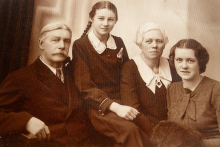
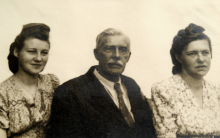
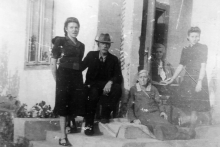
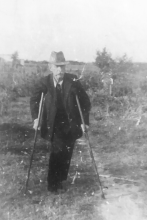
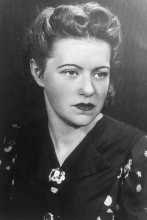
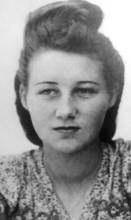
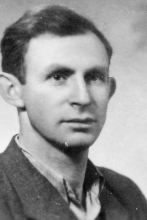
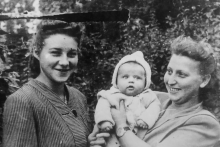
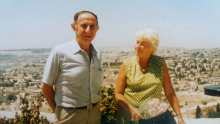
During World War II, Zygmunt and Wanda Brun, together with their daughters, Alina and Irena, lived in Ośnica Mała (Łuck District, Wołyńskie Province). Prior to the occupation by the Germans of nearby Łuck on 25th June 1941, Irena had worked in the town as a bank clerk. There, she befriended Dawid Princental who, later, ended up in a labour camp for Jews, established by the Germans on 19th October 1941. In the following December, they also established a ghetto.
When Princental found out about the first operation to exterminate the local Jews, which took place between 17th and 23rd August 1942 in the Łuck ghetto, he decided to go into hiding outside of the labour camp. In vain, he sought help from amongst his Polish and Ukrainian friends. At dawn, on 12th December, he returned to the camp. Meanwhile, in response to a further German extermination operation, the Jewish resistance movement had begun a revolt in the camp. Princental then decided to find his ex work colleague Irena Brun.
"I came to them in the evening and asked if I could spend one night there. Seeing the situation I was in, Mr. Brun agreed. I could feel the tension which fell upon their house that night", he recalled in his post-War memoirs. "The next morning brought with it an immense fear and the question, 'What do I do now? Where do I go?'.
I decided to distract myself by doing something. I went into the kitchen, lit a fire on the stove and began peeling potatoes for breakfast. My hosts were amazed to see me there but, at the same time, were pleased that some housework had been done before they had got up. (…) The outside of the window was showing the first signs of a severe and frosty winter. Because of this, my hosts didn't have the heart to urge me to leave their home. I remained with them for the next night and, again, I helped with the housework".
Princent's stay in the Bruns' home continued for close to six months. During that time, they supported him and treated him as a member of their family.
"Throughout that time, Mr. Brun tried to overcome the anxiety and tension which pervaded the home due to my stay. On more than one occasion, this was for serious reasons. One day, a Jew had been caught hiding with a Pole, Mrs. Wilk. She paid with her life for providing that help. Another message stated that Ryfka Barasz, a Jew, had been caught walking along the town's streets in the evening".
In the evenings, he would go out into the town and visit Christian friends. He endeavoured to learn if other Jews from Łuck were still alive and where they were hiding. Sometimes, he would go out for no specific purpose, risking his life. That was how he met Szmuel Szulman who was hiding on the terrain of the local brickworks. "I have no doubt that my stories raised the spirits of the Brun family. As time passed, I understood that people were more willing to help someone who is brave and that's what I tried to be".
At night, there would be many discussions with Zygmunt Brun. He was a former army officer and would talk about the Russian-Japanese war. He was certain that the end of the War was approaching. "The way various people think is interesting and the sources upon which they draw are interesting for the love of those closest to them. Mr. Brun, a military man, was not religious. He loved nature, animals, flora and, above all, he believed in humanity. In moments of depression, he would say, "Dawid, I'm old and I've see much in my life. I've reached the conclusion that everything passes, both the good and the bad. Believe me. The German occupation will pass like a bad dream”.
His wife, Wanda, was a very religious person. While preparing for Easter in 1943, she noticed the emotion which had overcome me. "She began comforting me. 'The day will come when you'll also start a family and you'll spend your holidays amongst people you love'. I remember that, another time, after a visit from a priest, she came out with her face covered in tears and said, 'Now, I'm completely calm. Father Bukowiński, the parish priest, told me that, in hiding a Jew in my home, I've obeyed the most important commandment'. After months full of tension, after all the sleepless nights, the moral support of the priest had somehow calmed her fears. (…) Spring entered the home through the window. I remember that heavy feeling when I saw trees and flowers blooming. Was it possible that, after everything which had happened, nature still remained the same?".
In the spring, Princental left the Brun home. He wanted to join the partisans, but his plan was not successful. Until liberation in February 1944, he remained in contact with them. After the War, he left for Israel.
In 1980, Zygmunt and Wanda Brun, together with their daughters Alina Hańko and Irena Gumułka, were honoured with the title of Righteous Among the Nations.