POLIN Museum Special Program marking the 80th anniversary of the end of World War II
For many people, the end of the war marked the end of one form of suffering and, at the same time, the beginning of another. The year 1945 was the beginning of an era of uncertainty, fear, mutual distrust, mourning for lost loved ones and a longing for what had been reduced to ruins.
For some, it was a time of desperately searching for family members. For others, it meant a childhood spent in orphanages. Yet for others, it was a period of piecing together memories and fragments of their lives – recalling the pre-war past, as well as the most horrific wartime experiences.
After 1945, many individuals continued to live in fear and grief, with a deep sense of loneliness. Under such circumstances, what does it mean to survive and try to go on living? How can one cope with trauma with the help of literature and art, or even in everyday life?
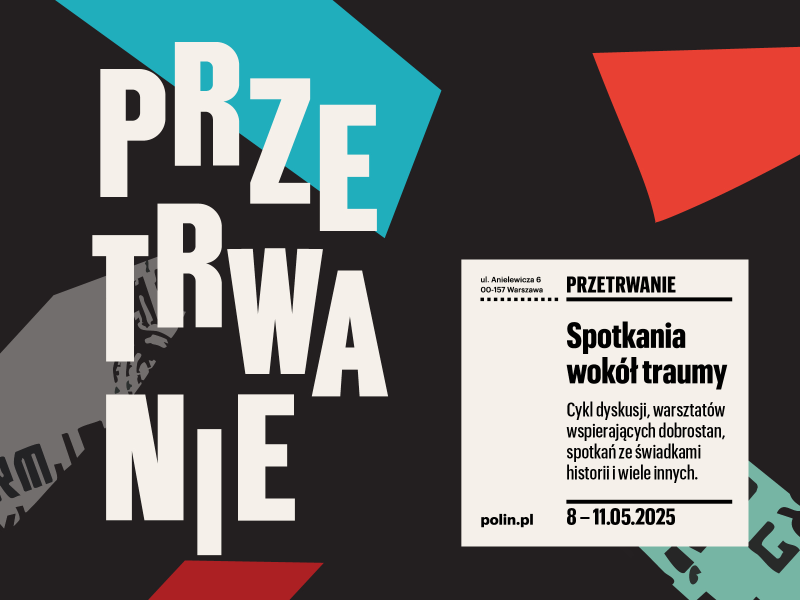
“Survival – Encounters Around Trauma” in the POLIN Museum
On the 80th anniversary of the end of World War II, we invite you to take part in a special program at the POLIN Museum.
On 8th-11th May 2025, we have prepared a series of discussions, well-being workshops, meetings with eyewitnesses, and many other events.
You can find the full program and free tickets on the POLIN Museum website:
View: “Survival – Encounters Around Trauma” – a program of events at the POLIN Museum →
We also encourage you to explore the POLIN Museum’s new publication, which reflects on a transformative process within our institution – changes which have allowed us, as staff, to support one another. This process began when we recognised how deeply the subject matter we engage with, at the POLIN Museum, affects how we feel and function in our work.
We hope that this publication “What Do We Feel at Work? Support in Cultural Institutions” will serve as a platform for staff members to express what they need and how those needs can be addressed through grassroots initiatives. In this publication, we share how such support can be fostered, how we approach it at POLIN Museum and why it is so important.
Our Temporary Exhibition – “1945 – Not the End, Not the Beginning”
The special program, “Survival – Encounters Around Trauma”, is part of the program accompanying the POLIN Museum’s temporary exhibition “1945 – Not the End, Not the Beginning”, which opened on 7th March.
This exhibition presents stories of Polish Jews, who survived the Holocaust, and their postwar experiences. It is a narrative about people who, amid the ruins of the old world, tried to rebuild their lives anew.
They were few in number – ninety percent of Poland’s Jewish community had been murdered. Stripped of nearly everything – their loved ones, their community, their home – they faced a dramatic choice – stay or leave? This exhibition invites us to see, through their eyes, the post-war reality.
The exhibition can be viewed until 15th September 2025.
“The Day That the War Ended” – a new article on the Polish Righteous portal
“Each survivor had his/her own day and place when the war ended for them. From the summer of 1944, when the Soviets liberated what is now eastern Poland, to the spring of 1945, when Germany officially surrendered. Paradoxically, the end of the war meant coming face to face with the Holocaust and grasping its scale”, from the introduction to the POLIN Museum’s temporary exhibition.
The topic of the end of the war and the memory of this event is an important theme in the testimonies of eyewitnesses from the POLIN Museum’s oral history collection. What did the day, marking the end of German occupation, look like? Under what circumstances did Jews emerge from hiding? What challenges did survivors face after leaving their hiding places?
Marking the 80th anniversary of the end of World War II, we give voice to the witnesses of history – Jewish survivors and those who helped them endure during the Holocaust.
Premiere 8th May 2025: The day when the war ended. Jews leaving hiding places (1944/1945) →
Read, view more:
- The attitudes of Poles towards Jews during the Holocaust [a thematic work] →
- The death penalty for helping Jews in occupied Poland [a thematic work] →
- Jews hiding on the “Aryan side” [a thematic cover] →
- Jews helping other Jews on the “Aryan side” [a thematic cover] →
- Expert discussion series – “In Hiding – the Stories of Survivors and the Righteous” →
- Educational film and discussion with experts about Irena Sendlerowa and Jadwiga Piotrowska →
- Educational film and discussion with experts about Jan and Antonina Żabiński →
- Interviews from POLIN Museum’s Oral History Collection [YouTube channel] →
- Artifacts from the POLIN Museum’s collection →