Discussion on the „Golden Harvest” at the Teatr na Woli
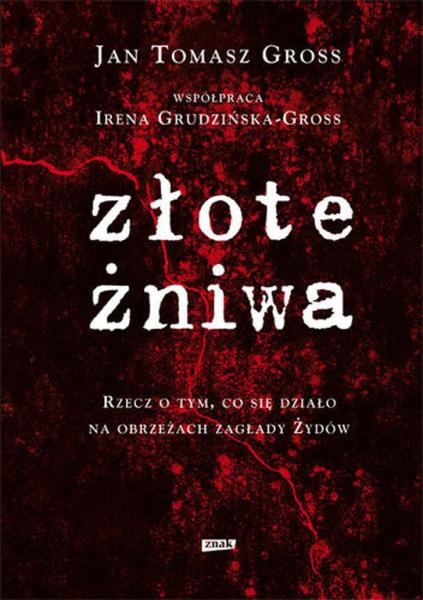
Apart from the authors, in the discussion participated Joanna Tokarska-Bakir, Alina Skibińska, Paweł Machcewicz and Marcin Zaremba. The debate was moderated by Roman Kurkiewicz. The stage was decorated with photograms from the play „Our Class” by Tadeusz Słobodzianek.
Irena Grudzińska-Gross and Jan Tomasz Gross emphasized the fact that Poles who killed Jews during the Second World War did not suffer social ostracism. What’s more, these murders were committed by well-respected members of village communities and in numerous cases the local community not only did not try to stop them, but also passively participated in the murders.
The authors also reminded that the Polish Righteous used to hide the fact they had rescued Jews. To this day, the rescuing remains an act that can expose to ostracism in many local communities.
Irena Grudzińska-Gross and Jan Tomasz Gross said that murdering Jews during the Nazi occupation was a certain “norm” and “social practice”.
These terms moved the participants of the debate – Marcin Zaremba and Paweł Machcewicz were strongly opposed to that opinion. Alina Skibińska emphasized the scale of the phenomenon and Joanna Tokarska-Bakir tried to show that within one group numerous “norms” can exist at the same time.
Tokarska-Bakir also accused a part of Polish historians of being barbaric, because they confuse the historic essay “Golden Harvest” with other genres and in consequence use the wrong tools to criticize it. In her opinion readers should not expect extreme precision and “an arithmetical balancing of arguments of both sides” from that book.
This opinion was considered as controversial by the historians Marcin Zaremba and Paweł Machcewicz. The latter accused the authors of passing over sources that do not match their thesis and said that their perspective was selective and one-sided.
Gross answered: “There is no book that would objectively present Polish-Jewish relations during the Second World War. No publication devoted to the Żegota contains the whole truth about these relations. And it is only when having all those terrifying facts before our eyes that we can truly appreciate those who rescued Jews”.
In spite of the controversy, all the participants agreed that the scale of the phenomenon was much bigger than researchers believed 10-15 years ago and that Jan Tomasz Gross found a way to bring this subject into the public debate.
In the last part, when the audience had the opportunity to share their opinions, someone said: “I am the daughter of a person who was really involved in rescuing Jews. I feel extremely sad that today we do not come to an agreement. All of us present our own views but nothing more happens. When will finally Poles admit: »Yes, we did it«. And when will Jews, thanks to such a statement, have the opportunity to answer: »We forgive you because you had the courage to say yes«?”.