72nd Anniversary of the Establishment of the Council to Aid Jews Żegota
In occupied Europe, Żegota was the only state organisation to save Jews from the Holocaust, working under the auspices of the Polish Government-in-Exile. Its members comprised people of various political viewpoints, both Poles and Jews. Professor Władysław Bartoszewski was one of the founders of the Council. He was twenty years old at the time. During his meeting with the students, the Professor spoke about his motivations and his activities in Żegota which were directed at helping Jews.
Asked about his motivations the Professor described the environment in which he had been raised – intellectual and Catholic, yet also very open. Amongst his friends were both Poles and Jews. As a young man, he ended up in the Auschwitz concentration camp. The atrocities he witnessed there led to into a crisis of faith. Upon leaving the camp in 1941, a priest who heard his confession impelled him to help Jews. He decided to join the underground. In the summer of 1942, he decided to join the Poland Revival Front, a Catholic organisation, at whose initiative the Temporary Committee to Aid Jews was formed. Żegota followed soon afterwords.
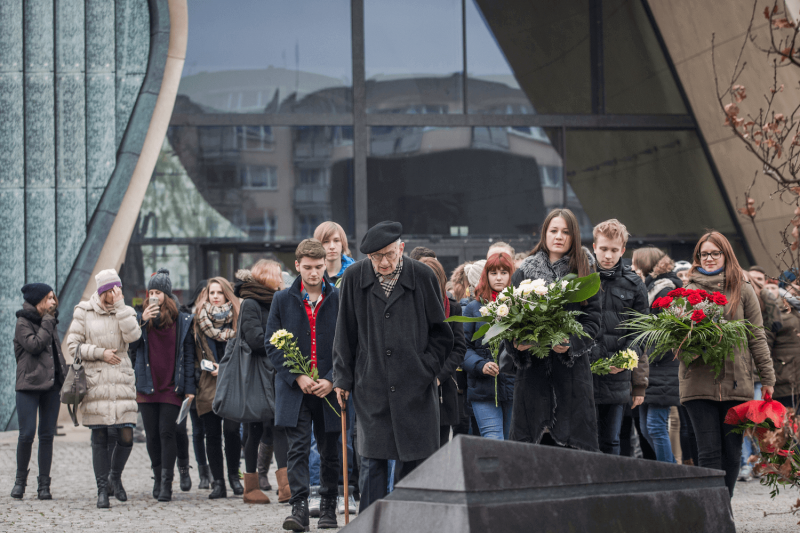
The Professor also spoke of Żegota’s activities. He stressed the service of one of its members, Irena Sendler, who activities centred on saving children. In response to students’ questions, he also spoke about his later professional life. Following the meeting, accompanied by the students, the Professor laid flowers at the Żegota monument, located near the entrance to the Museum.
The Council to Aid Jews Żegota was established on 4th December 1942, as a branch of the Polish Government-in-Exile. It continued the underground work of the Temporary Committee to Aid Jews which, a few months earlier, had been founded by writer Zofia Kossak and Maria Krahelska-Filipowiczowa. Żegota helped Jews in hiding on the so-called Aryan side. It provided them with food and money, as wells as arranging false papers for them. Jews were also helped to find places in which to hide. Many children were placed into care or with Polish families where they survived the War. Żegota operated actively until the end of the War, mainly within Warsaw, but also later in Kraków and Lwów. Its members comprised people of various political viewpoints, both Poles and Jews.
We invite you to view the virtual exhibition on the Council to Aid Jews Żegota, via our website www.sprawiedliwi.org.pl. The exhibition tells of the establishment of the Council, its members and its activities.
The exhibition is part of the Polish Righteous - Recalling Forgotten History project, dedicated to the Polish Righteous Among the Nations – people who helped Jews during the Holocaust, risking their lives and the lives of their families. Stories of help are documented and presented at www.righteous.pl.