International Holocaust Remembrance Day
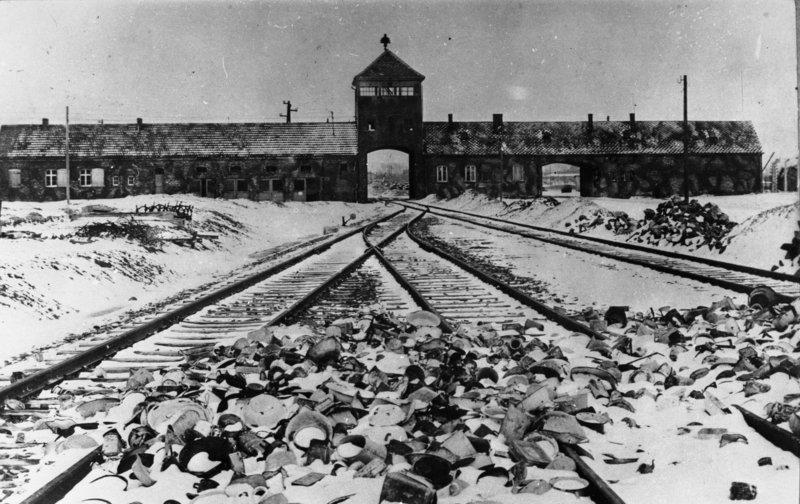
They brought us to a room where our hair was cut,
we were dress in striped uniforms and numbers were burned into our arms.
At that moment, I was no longer called "Lusia".
I had become a number.
– Pnina (Lusia) Segal, Holocaust Survivor
On 27th January 1945, soldiers of the 60th Army and Ukrainian Front entered the German Auschwitz concentration and extermination camp. In the mother-camp, Auschwitz I, in Auschwitz II (Birkenau) and in Auschwitz III (Monowitz), barely 7,000 prisoners awaited liberation. The majority of Germans managed to head west on a death march.
Read more about the liberation of Auschwitz »
Citizens from almost every German-occupied country were imprisoned and murdered in Auschwitz. The vast majority were Jews. More than 1.1 million people did not survive to see liberation. They perished in the biggest of the Nazi death factories. Despite the large number of Holocaust victims, none have their own grave. Their memory is passed on by people, places of commemoration and by institutions.
Since 2005, at the initiative of the United Nations, the anniversary of the liberation of Auschwitz has been commemorated, around the world, as International Holocaust Remembrance Day. Each year, we refer visitors to our Polish Righteous website to selected stories from the collection of POLIN Museum of the History of PolishJews.
Read Stories of Holocaust Survivors
It is difficult to find the words to describe the immensity of the cruelty that was the Holocaust. The words of those who survived are more important. To mark International Holocaust Remembrance Day, we present selected stories from POLIN Museum's collection. They are based on interviews with witnesses to history. We recall the stories of Halina Aszkenazy-Engelhardt, Matti Greenberg, Roman Kent, Shalom Lindenbaum, Pnina Segal, Sally Wasserman and Samuel Willenberg. We also recommend viewing ome of our oral histories.
POLIN Museum collections also contain artefacts which remind us of the tragic fate of Jews during the Holocaust. They tell of life in ghettoes, in hiding and in concentration camps. They tell of Jewish children and exiles and of the sense of emptiness and lonliness felt by survivors. Thanks to these artefacts, today, we can recount the stories of Bronia Morgenstern, Krystyna Sigalin, Romuald Waszkinel and others, whose existence is confirmed today by only single items.
Read to the stories »
View the interviews »
See the artefacts »
Also, this year, the World Jewish Congress is again conducting an Internet campaign involving thousands of people and organisations around the world, posting their photos, holding a card with the hashtag #WeRemember. Stories of Holocaust Survivors, bearing this tage, can also be found on our Facebook page »
Visit POLIN Museum
International Holocaust Remembrance Day events in Warsaw will commence on Sunday 27th January at 12:00 noon at the Ghetto Heroes Monument. Also, as every year, the Shalom Foundation, orgaisers of this ceremony, is asking people to light a symbolic candle in their window at 6:00pm.
On the same day, between 12 noon and 6:00pm, an empty tram, bearing a Star of David, will run through the Warsaw streets which lie in the area which was once the Warsaw Ghetto. It is intended to remind Warsaw residents of their Jewish neighbours who perished in the ghettoes and death camps. The tram's route will be: Plac Narutowicza – Filtrowa – Nowowiejska – Marszałkowska – Andersa – Stawki – al. Jana Pawła II – Popiełuszki – Metro Marymont – Popiełuszki – al. Jana Pawła II – Okopowa – Towarowa – Plac Zawiszy – Plac Narutowicza.
On 27th January, POLIN Museum also invites you to a screening of the Polish-American film Kto napisze naszą historię? (Who WIll Write Our History?) directed by Robert Grossman. This docu-drama tells the story of the Ringelblum Archive – a collection of documents which constitute one of the most important testimonies to the Holocaust of the Jews. The film stars Karolina Gruszka, Jowita Budnik, Piotr Głowacki and Wojciech Zieliński. The screening will be immediately followed by a broadcast of a meeting with the filmmakers to be held at UNESCO headquarters in Paris. More information about the screening »
On the following day, POLIN Museum will host the launch of a book by Laurence Rees entitled. The Holocaust – a New History, published by Wydawnictwa Prószyński & Company. After hundreds of discussions with Holocaust survivors, its perpetrators and with eyewitnesses carried out over twenty five years, in his latest book, Laurence Rees combines their testimonies with the latest findings by historians, creating a chronological account. Read more about this event »
Also, view the exhibition “Between Life and Death” »
* * *