Władysław Bartoszewski Honoured on 74th Anniversary of “Żegota”
When, on 16th November 1940, the Warsaw ghetto was sealed off, the Petty Offences Court became part of the border. While it was not actually a part of the ghetto, Jews were able to enter that space. Jews entered the Court building from Leszno Street, while non-Jews entered from Biała Street. Everyone who entering the building was monitored by Jewish, Polish and German police, who were posted at all of the building’s entrances. Only those with official court business were meant to enter the premises, however, above all, the building was used as a meeting place and as a site for conducting illegal activities such as smuggling. It also functioned as a kind of exchange for currencies and precious metals. The court also served as one of the most popular and convenient sites for escaping from the ghetto to the “Aryan side”.
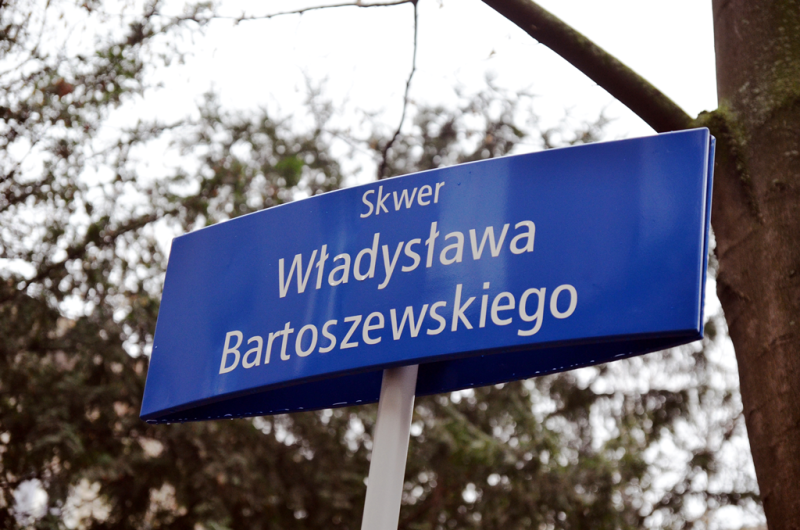
The idea to honour Władysław Bartoszewski in this symbolically important place was supported by the then Polish President Bronisław Komorowski and the German President Joachim Gauck. It also received broad community support. For this reason, Warsaw Mayor Hanna Gronkiewicz-Waltz agreed to waive the five-year waiting period following the death of a proposed patron and permitted the City Council to vote on the matter. On 20th October 2016, the Council agreed to the project.
Those who took part in the ceremony on 4th December 2016 included Władysław Bartoszewski’s son, Władysław Teofil, representatives of the Warsaw municipal authorities, the President of the Constitutional Court Andrzej Rzepliński, representatives of the Sejm and Senat, veterans and many members of the Warsaw public.
During the ceremony, Hanna Gronkiewicz-Waltz described Władysław Bartoszewski as “the symbol of the fight for a democratic state, of a European and open Poland”. She stressed that it was “worth imitating that attitude”.
In a letter to ceremony participants, Israeli Ambassador Anna Azari stated, “He was one of the architects of Polish-Israeli relations and, if we say today that these relations can be called strategic, then we have him to thank for that”.
Three days following the ceremony, the square was attacked by vandals. The damage was reapired immediately and the City Council is planning changes to the space itself.
Very soon, a square in Raciborz will also be named in honour of Władysław Bartoszewski.
Władysław Bartoszewski (1922-2015) was a soldier in the Home Army (AK), a participant in the Warsaw Uprising, a prisoner in the Auschwitz-Birkenau camp, a member of the Council to Aid Jews “Żegota” and a Righteous Among the Nations. In post-communist Poland, he served as Minister for Foreign Affairs. He was a columnist, a historian, a writer and a social activist. In his last years, he served as an advisor, to the Prime Minister, on matters relating to international dialogue. His story can be found on our website.