A New Publication from the Polish Centre for Holocaust Research
"A young woman is following me. On her back, she's carrying a bundle. A German, with a satanic smirk on his face, approaches her, raises his whip and slams it down on the rucksack. An horrific shouts resounds from the hidden child. The German tears the baby away from the woman and forces her, together with the rucksack, against a wall. This poor wretch wants to go after the child. The torturer reels with laughter - the scene amuses him. The woman, beaten with the whip butt, is forced back into the ranks" - an extract from the diary of Mirka Piżyc.
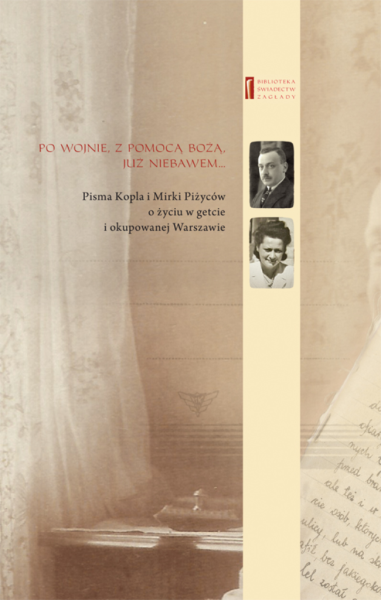
"With God's help, the war will end soon…” The writings of Kopel and Mirka Piżyc about life in the ghetto and in occupied Warsaw are the writings of a father and daughter, written following the escape from the Warsaw Ghetto into hiding on the "Aryan side". Kopel was a Zionist and a social activist. In the ghetto, he was among the organisers of Hebrew education and a children's choir. His notes concern ghetto life, his community activities and the fate of his entire family, the majority of whom perished. By the beginning of the War, Mirka had already matriculated and dreamed of studying medicine. In the ghetto, she worked in an orphanage. She described life in the ghetto, from the time of the major liquidation operation (July-September 1942) until the beginning of the Uprising in April 1943 when, together with her father, she managed get out of the ghetto. Mirka's younger sister, Rutka, together with her mother, had left the ghetto a week earlier. All four survived in hiding places on the "Aryan side". After the War, the Piżyc family left for Sweden from where they then migrated to Israel.
"At this time, I worked in (…) an orphanage which cared for more than six hundred orphaned Jewish children (…). They had wandered the ghetto streets, (…) begging, eating raw and rotten vegetables from the rubbish bins. They gnawed on discarded bones. (…) they were taken into care (…). The lice were removed, their scabies was treated, they had their own bed, bedding and decent clothes (…). They has full bowls of food (…). Rumours of deportations, circulating around the ghetto, reached us and our (…) children. (…) Lolek and Jadzia, Henio i Rywcia hit me with questions, 'Is it true? Miss Mirka, Miss Mireczko, will they send us away? Will we be homeless again? Please tell us that it isn't true!'. 'I don't want to be alone again, please don't leave me', sobs Mendele, as tears rolls down his face. What can I tell you, my dear little boy - that unfortunately it's true, that it's a terrible, inexorable truth? (…) Oh no! Delude yourself while you can. And so I explain that homes like this one won't be affected (…)”.
This publication has been prepared and contains an introduction by Barbara Engelking (the Polish Centre for Holocaust Reseach Association) and Havi Dreifuss (Yad Vashem).