Maria Piechotkowa Honoured for Her Commitment to Preserving Poland's Jewish Heritage
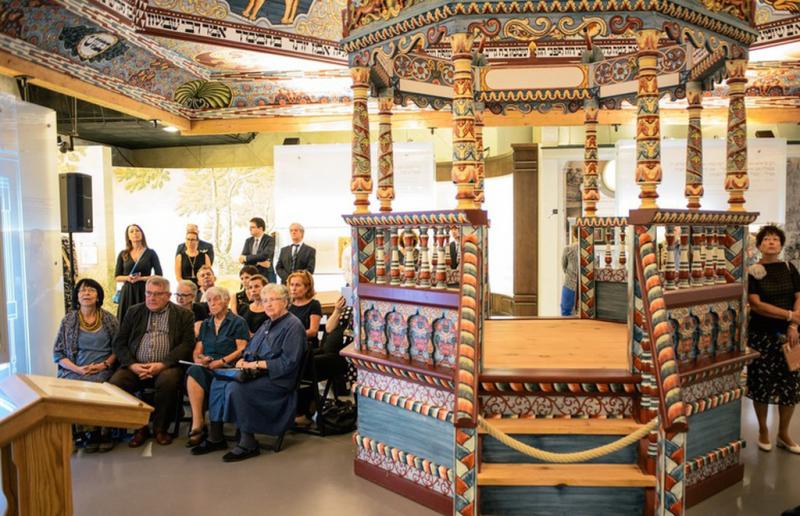
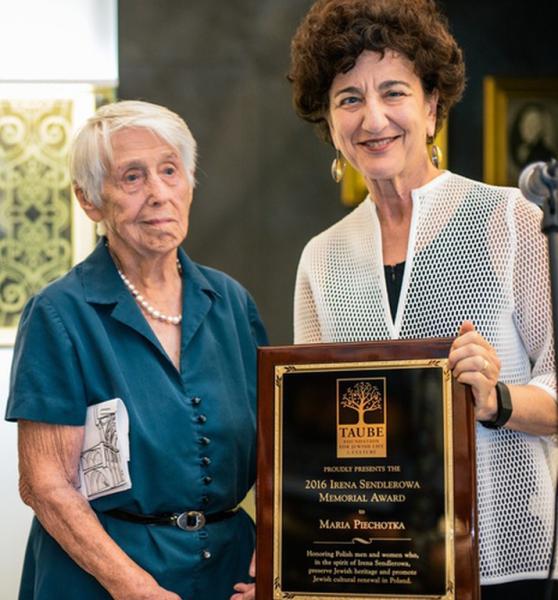
The Award, was presented by the Taube Philanthropies foundation during a ceremony held on 16th September 2016, under the reconstructed vault of the Gwoźdźiec synagogue at the POLIN Museum of the History of Polish Jews.
In presenting the a
ward, Shana Penn, Taube Philanthropies Director said, "It is not a coincidence that we gather here beneath this wonderful painted replica. We wish to honour Maria Huber-Piechotka in this place because the creation of this replica, and the revival of Jewish culture in present-day Poland are examples of what can be achieved through pioneering vision, passion and determination such as that shown by Maria Piechotka and her late husband Kazimierz. They rescued timber synagogues from total oblivion, preserving the memory of their architectural significance and beauty. At the same time, they ensured a place for them in Polish and Jewish history and culture for future generations”.
She added that, "Poles and Jews, those living inside Poland and abroad, owe a great debt to the Piechotka couple for their historical work in restoring and strengthening the memory of those timber synagogues, which represent the Jewish heritage in Poland. Their involvement and knowledge can be passed on to future generations of students of architecture, the arts, history, religion and culture. Thanks to their work, Jews and Poles, together, can be proud of their culture."
Maria Piechotka took part in the Warsaw Uprising. Already, by 1944, she had begun work on documenting the architechtural details of destroyed buildings, particularly timber synagogues. Together with her husband, Kazimierz Piechotka, she authored a series of books on this subject, among them being Bramy nieba. Bożnice drewniane na ziemiach dawnej Rzeczypospolitej (The Gates of Heaven - Timber Synagogues Within the Former Republic) published in 1957, which was a watershed publication in this field of work. In 2000, YIVO presented Maria and her husband with the Jan Karski and Pola Nireńska Award.
"Thanks to her crucial vision of a multicultural Poland, Maria Piechotka had a significant and long-term influence on Polish society, contributing to the preservation of Poland's Jewish heritage", said Tad Taube, President of the Taube Philanthropies Foundation, and Polish Honorary Consul in San Francisco. "The Piechotka's important and pioneering research constitutes and endless source of inspiration for future generations of scholars and architects whose are interested in the timber synagogues”.
Among those present at the ceremony were Ewa Czerniawska, representing the President of Poland Andrzej Duda and the President's Chief of Staff Adam Kwiatkowski, Rafał Perl representing the Polish Minister of Foreign Affairs, Chief Rabbi of Poland Michael Schudrich, Maria Piechotka's sons Michał and Maciej Piechotka (both architects) and Katarzyna Zachwatowicz, daughter of architect Jan Zachwatowicz, who created the concept of rebuilding post-War Warsaw, especially the Old City, and who served as mentor to Maria and Kazimierz Piechotka.
The Irena Sendler Award
The Irena Sendler Award was established in 2008 by the Taube Philanthropies Foundation as a tribute to Irena Sendler, the Polish nurse who rescued children from the Warsaw ghetto during the Holocaust. It is presented to Polish citizens in recognition of their efforts in preserving and renewing this country's Jewish heritage.
Past Award recipients include Janusz Makuch, Director of the Krakow Jewish Festival (2008), Jan Jagielski, historian at the Jewish Historical Centre (2009), former Polish President Aleksander Kwaśniewski (2010), the late Magda Grodzka-Gużkowska who risked her life helping Irena Sendler save Jewish children from the Warsaw ghetto (2011), outstanding researchers Prof. Dr Maria Janion and Dr Jolanta Ambrosewicz-Jacobs (2012), Bogdan Zdrojewski, Minister of Culture and National Heritage, Hanna Gronkiewicz-Waltz, Mayor of Warsaw (2013), Małgorzata Niezabitowska, writer and journalist, Tomasz Pietrasiewicz, Director Ośrodka „Brama Grodzka – Teatr NN” (2014), Krzysztof Czyżewski, Director of the Borderlands Foundationsand the late Dr Jan Kulczyk, major benefactor of the POLIN Museum of the History of Polish Jews (2015).