New Righteous Honoured on the 70. Anniversary of the Founding of "Żegota"

The proceedings began with Professor Władysław Bartoszewski, the last surviving member of Żegota. The professor stressed that it was the only organisation in Europe actively saving Jews from the Holocaust, operating beyond political and religious divisions. Referring the event for youth organised by the Museum of the History of Polish Jews at the Żegota monument, the professor emphasised the importance of young generations remembering that organisation and its activities.
The Israeli Ambassador, Zvi Rav-Ner, spoke of Israel’s obligation to honour those who had helped Jews during the War. Kamila Radecka-Mikulicz, co-ordinator of the Holocaust Gallery in the Museum of the History of Polish Jews, then spoke of the help provided to Jews in occupied Poland.
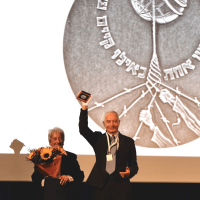
The Righteous were then acknowledged. A medal and certificate were presented to the descendants of those honoured.
The first recipient was Leon Godlewski of Gdańsk, son of Helena Godlewska who, in the summer of 1942, cared for a young Jewish girl, Masza Bornstein, known by everyone as Misia. Also honoured were Maria and Michał Golb who hid three Jews in their farm located near Połaniec (Świętokrzyskie Province). Those hidden were Hanna Kurz, as well as Tonia Szulkind and her son Natan. The medal was accepted by the children of the Righteous.
Leokadia and Antonii Jastrząb were honoured for helping their Jewish neighbour, Priwia Grinkraut. Their daughter, Liliana Wierzbińska, accepted the medal. Also among those honoured was Aniela Woroniecka (neez Czartoryski), who hid a group of Jews in her apartment on ulica Nowogrodzka in Warsaw. Róża Chmielewska was also acknowledged as Righteous, who casually suggested to her husband that they should provide help. She was a prostitute who saw her clients in her apartment on ulica Krucza in Warsaw. Edward Reicher, who was hiding there, had to remain in a special hiding place.
All those honoured above, and those whom they aided, survived the War. However, this was not the case with Stanisława Olewnik of Krzemień, near Maków Mazowieck. She helped the five-member Mławski family, escapees from the Maków ghetto. In the autumn of 1943, the Mławski family were caught by the Germans. Under torture, one of the Jewish girls revealed that Stanisława Olewnik had hidden her in her home over a period of time. All were sent to Auschwitz where they perished. On behalf of Stanisława Olejnik’s son, the honour was accepted by the Mayor of Grodzisk Mazowiecki.