2025 European Day of the Righteous


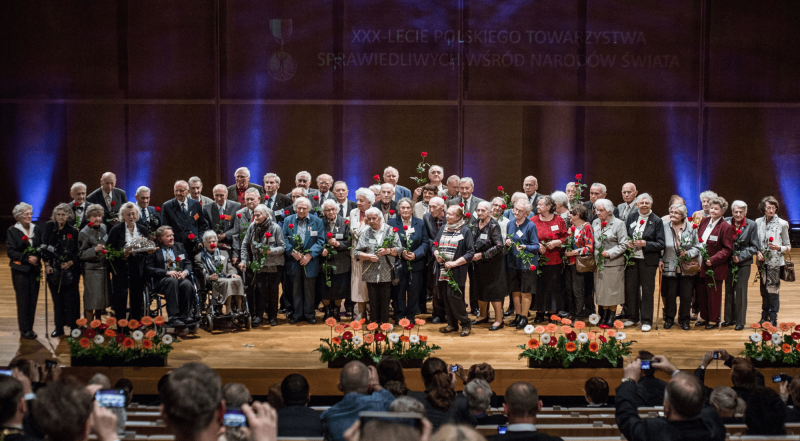
Every year, on 6th March, the European Day of the Righteous, the Committee of the Garden of the Righteous Foundation announces the names of individuals, who have demonstrated noble deeds in their lives.
These individuals are commemorated in the Garden of the Righteous in Warsaw – trees are planted, in their honour, and memorial stones are unveiled. The annual ceremonies, honouring the new Righteous, provide an opportunity to remember and tell their stories, as well as to educate about human rights.
The Committee of the Garden of the Righteous Foundation, which selects the newly honoured for the title of “Righteous”, consists of distinguished individuals from the fields of culture, science and education, as well as representatives of non-government organisations. Any individual can submit a nomination by sending their proposal to the Garden of the Righteous Foundation.
What does the title “Righteous” mean?
This concept is universal and serves to commemorate all individuals who, in Europe and beyond, saved human lives or defended human dignity and freedom under totalitarian regimes, during genocides, mass murders and crimes against humanity, committed in the 20th and 21st centuries.
This concept is broader than the title of Righteous Among the Nations, awarded by the Yad Vashem Institute in Jerusalem – an honorary title granted by the State of Israel to non-Jews for helping to Jews during World War II.
Who are this year’s “Righteous”?
On March 6th, during the European Day of the Righteous, the names of the individuals, who were honoured with the title of “Righteous” by the Committee of the Garden of the Righteous Foundation, were announced: Iryna Cybuch, siblings Sophie and Hans Scholl, and Marian Turski.
Iryna Cybuch (1999–2024)
A Ukrainian journalist, paramedic and nurse, pseudonym “Czeka”, She died, on 29th May 2024, on the front line in the Donbas region.
She studied at the Faculty of Journalism at Lviv Polytechnic University. After completing her studies, she moved to Kyiv, where she began master’s degree studies at the Higher School of Economics.
Prior to 24th February 2022, she was a project manager at Suspilne (a Ukrainian public television program). She created documentaries and worked as a media trainer. She also carried out educational projects in villages in the Donetsk and Luhansk regions.
She volunteered for the war. From 2015, she travelled to the front lines as a paramedic and, in 2022, she permanently joined the military rescue group of the Hospitallers. On her blog, she described the life of medics on the front lines. Iryna was involved in evacuating the wounded from the battlefield.
In an interview, Iryna Cybuch said:
“I really want to survive and live the way I planned. I’m a young girl, just like any other in France or Spain. The only difference is that we have a totalitarian regime at our border, which has attacked the country I love so much. I like to travel, but I want to live here. That’s why I defend my country, that’s why I’m ready to die helping others.”
“I want the liberal world, which I respect, to appreciate our strength. We could be just as liberal and soft, but we can’t afford that, because the Russian regime wants to destroy us. [...] I want to have children. I want a home. I want to plant tomatoes [...], but the most important thing is to end the war.”
In November 2023, she was awarded the Order of Merit, Third Class, by the President of Ukraine and, in March 2024, she received the “Strength of Women” award from the “Ukrainian Truth” portal.
She died on 29th May 2024, two days before her 25th birthday. Before her death, she left instructions on how her funeral should be conducted. Instead of flowers, she asked for donations to the battalion and assistance for the families of those, who had fallen on the front lines. She also requested that attendees wear embroidered or camouflage shirts and that everyone sing Ukrainian songs. The farewell ceremony in Kyiv wsas attended by hundreds of people at the Orthodox Church of St. Michael the Archangel.
“You were the best of us – consistent in your actions, words, and principles. Even in fear, even when you looked at death with great confidence and laughed in its face. Ira, you saved so many, but and we couldn’t save you”, wrote her friend, Julia Kochetova.
On 3rd June 2024, her hometown of Lviv farewelled her in a crowded ceremony at the Garrison Church (formerly St. Peter and Paul Church and the Jesuit Monastery). She was laid to rest at the Łyczaków Cemetery.
Sophie Scholl (1921–1943), Hans Scholl (1918–1943)
The siblings, members of the “White Rose” anti-Nazi resistance movement, were executed by the Gestapo.
Sophie and Hans grew up in a family with liberal and anti-Nazi views. Initially, like many of their peers, they were members of Nazi youth organisations but, over time, they began to recognise the true nature of the regime and strongly opposed it.
In 1942, as students at Munich University, they became involved in the activities of “White Rose” – a resistance movement which, through leaflets and peaceful actions, called for opposition to Nazism. In their writings, they appealed to German society to resist and informed them about the crimes of the regime.
Arrested in February 1943, they were tortured by the Gestapo and refused to renounce their beliefs.
On 22nd February 1943, for alleged treason, Sophie and Hans Scholl were executed by guillotine. A similar fate befell the few remaining members of the organisation.
After their deaths, the Allied air force dropped millions of “White Rose” leaflets over Germany, ensuring that their message reached the German populace. Their courage became a symbol of resistance against tyranny.
Today, in Germany, their names are carried by streets, schools and squares, serving as symbols of steadfastness in times when few had the courage to defend their beliefs and resist.
Marian Turski (1926–2025)
A Holocaust survivor, prisoner of the German Nazi concentration camps Auschwitz and Buchenwald, historian, and journalist, he was a friend and co-founder of the POLIN Museum of the History of Polish Jews.
He was a historian, journalist, social activist, Holocaust survivor and prisoner of the German Nazi concentration camps Auschwitz and Buchenwald.
He was born in Porzecze to Eliasz and Estera Turbowicz, spending his childhood and youth in Łódź. In 1944, his family was deported to Auschwitz – his father and brother perished in the gas chambers and his mother was sent to the Bergen-Belsen camp.
Turski, registered as prisoner number B-9408, worked on road construction at Auschwitz-Birkenau and later in a sub-camp in Czechowice, where he remained until January 1945. He survived two death marches – from Auschwitz to Wodzisław Śląski and from Buchenwald to Terezín, where he was liberated in a state close to death.
After the war, in 1945, he returned to Poland and joined the Polish Workers’ Party. He began studying history at the University of Wrocław,while also engaging in journalism. In 1949, he moved to Warsaw, where he worked in the editorial offices of “Sztandar Młodych” and “Polityka” , where he was responsible for the historical section.
In 1964, on a scholarship, he went to the United States, where he participated in events for civil rights, including the march to Montgomery, organised by Martin Luther King.
March 1968 was a turning point for Turski, who, after the antisemitic campaign in Poland and the invasion of Czechoslovakia, distanced himself from the communist regime. After 1968, he continued his journalism and academic work. In 1975, he wrote the book “The Peace Movement – People, Facts. From the History of the Polish Peace Defenders Movement” and initiated the publication of memoirs of Holocaust survivors.
In 1985, he travelled to Israel and, in 1989, he became a member of the Founding Committee of the Association of Jewish Combatants and Victims of World War II. Turski was also the author of the monumental project “Jewish Fates – The Testimony of the Living”, which was published in three volumes between 1996 and 2001, containing the stories of over 120 Holocaust survivors.
For many years, Marian Turski never shared his camp experiences. He first visited Auschwitz in the 1970s – for the first time since the war. He described the repression of camp memories in interviews as a 20-year-long amnesia.
Marian Turski was deeply involved in the creation of the POLIN Museum of the History of Polish Jews, where he held important roles, including chairing the Museum Council and serving as vice-chair of the Association of the Jewish Historical Institute in Poland.
He was also a member of the International Auschwitz Committee, the International Auschwitz Council and the Council of the Memorial Site at the Wannsee Conference in Berlin.
Marian Turski’s tireless efforts to preserve Jewish heritage, warn against crimes based on racial and religious grounds, combat the exclusion of minorities and raise awareness of acts and speech of hatred earned him numerous awards and honours, both in Poland and abroad.
Marian Turski passed away on 18th February 2025, in Warsaw.
Read more: Biography of Marian Turski on the “Virtual Shtetl” portal →
So far, those honoured in the Garden of the Righteous in Warsaw include:
Władysław Bartoszewski, Mosze Bejski, Arseny Borisovich Roginsky, Hrant Dink, Marek Edelman, Bronisław Geremek, Natalya Gorbanevskaya, Magdalena Grodzka-Gużkowska, Wilhelm Hosenfeld, Petro Hryhorenko, Julia Ilisińska, Jan Jelinek, Gareth Jones, Jan Karski, Siergei Adamovich Kovalyov, Roberto Kozak, Jacek Kuroń, Raphael Lemkin, Ewelina (Ewa) Lipko-Lipczyńska, Antonia Locatelli, Nelson Mandela, Alfreda Markowska, Hasan Mazhar, Tadeusz Mazowiecki, Karol Modzelewski, Stanislav Yevgrafovich Petrow, Witold Pilecki, Anna Politkovskaya, Emanuel Ringelblum, Amer Abu Sabila, Vivian Silver, Andrzej and Klemens Szeptyski, Raoul Wallenberg, Armin Wegner, Antonina Wyrzykowska, Liu Xiaobo, Jan Zieja, Adalbert Wojciech Zink, Antonina and Jan Żabiński.
The Garden of the Righteous Foundation works in the field of human rights, particularly in commemorating and promoting the deeds and biographies of the Righteous individuals who, in Europe and beyond, saved lives or defended human freedom and dignity – during Nazism and Communism, genocides, mass murders and crimes against humanity committed in the 20th century and ongoing today. The foundation aims to democratise the world by supporting and conducting educational activities which encourage an atmosphere of understanding, trust, and respect beyond national, religious and cultural divisions.
The foundation oversees the Garden of the Righteous in Warsaw (Gen. Jan “Jura” Gorzechowski Square), which was established in 2014 at the initiative of the History Meeting House and the GARIWO Foundation, with the support of the then Prime Minister of the Republic of Poland Tadeusz Mazowiecki and the authorities of the Wola district of Warsaw. Partner of the Garden is the POLIN Museum of the History of Polish Jews.