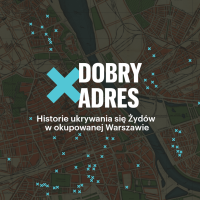
A Walking Guide: Those in Hiding and Rescuers – Saska Kępa and Grochów During the Holocaust


“Thanks to these noble people, my cousin and I were saved from certain death […]”
With these words, Stanisław Rudnicki attested to the help which he received, during World War II, from Stanisław and Anna Górski, who were honoured with the title of Righteous Among the Nations.
This and other stories of Jews in hiding and their rescuers – including Leokadia Pycek, Juliusz Saloni and his wife Jadwiga Strzelecka and the Bukowiński family – can be found in the walking guide published by the FestivALT Association.
This coming weekend, a guided walk through Grochów will take place, following the traces of these stories of aid.
Join the walk through Grochów
- When? 12th October 2025, 1:00 pm
- Where? Assembly point on pl. Szembeka
- Free event
- Registration is required: https://forms.gle/zv4YjJkpEqWW6Xii6
“Join us as we uncover little-known stories of Jews in hiding and the Poles, who helped them, in Warsaw’s Grochów district”, say the event’s organizers.
The walk will be led by Jerzy Tarłowski – a museologist, cultural expert, and a lifelong Grochów resident. Don’t miss the chance to see Grochów from a new and extraordinary perspective.
View the walking guide online
The walk accompanies the release of the walking guide “Those in Hiding and the Rescuers – Saska Kępa and Grochów During the Holocaust”. It is an interactive guide available in the Echoes app, which offers an audio walking experience – allowing you to hear the stories of people, who once lived here and to feel the atmosphere of places where the past meets the present.
The authors of the guide write, “the Warsaw district of Praga Południe holds extraordinary stories from World War II. They are the stories of Jewish people seeking shelter to survive, and of Polish people, who risked much to help them. We share these Polish-Jewish narratives to show how they forever changed the face of this area”.
What will you find in the walking guide?
-
An audio walk: An audio track is available, in the Echoes app, to guide you through places full of history. You will hear eyewitness stories, sounds of the streets from the past, and you will learn more about the fates and attitudes of extraordinary people.
-
An Intuitive map: Using an interactive map, you can discover locations, where Jews sought shelter and Polish families offered help, risking their own lives.
-
A free e-book: The walking guide is available as a free PDF e-book in both Polish and English. Download it to learn the stories of those fighting to survive in wartime Warsaw.
-
Education and remembrance: The project is not just a guide. It is also an educational tool, which helps deepen understanding of everyday life during the war and reveals the realities of the “Aryan side” of occupied Warsaw.
The walking guide publisher and the organiser of the walk is the FestivAlt Association – a Jewish organization which operates at the intersection of art, activism and education, addressing difficult and current issues in complex Polish-Jewish relations of contemporary Poland.
On the Association’s website, they write, “we challenge stereotypes and promote new ways of thinking about Polish-Jewish matters in today’s Poland. We often address topics which, for decades, have been ignored or swept under the rug, leading to the normalisation of problematic behaviors, attitudes, and situations”.
The walking guide was developed with the comprehensive cooperation of the POLIN Museum of the History of Polish Jews, using the Museum’s digital collections, including archival materials, photographs, and oral history interviews.
Discover stories of rescue from Saska Kępa and Grochów on the Polish Righteous portal:
- „Mamy jedną Polkę, panią Lodzię”. Historia pomocy udzielanej przez Leokadię Pycek
- „Coś się pomogło”. Historia Juliusza Saloniego, Jadwigi Strzeleckiej i Ireny Dąb Jinich
- „Dzięki tym szlachetnym ludziom zostaliśmy uratowani”. Historia rodziny Górskich
- Bezinteresowna pomoc. Historia Zofii Bandurskiej-Hermanowej i Marka Przeworskiego
- „Pamiętam silny uścisk jego ręki”. Historia rodziny Bukowińskich
- „Popełnił samobójstwo, by na tortury go nie wzięli”. Historia rodzina Pokropków
- „Nigdy nie przypuszczałam, że będę kiedykolwiek o tym świadczyć”. Historia rodziny Karolickich i innych osób żydowskich ukrywających się na Grochowie
Read and view more:
- Recommended stories – the ten most famous Polish Righteous Among the Nations [catalogue of stories of rescue] →
- Members of the “Żegota” Council to Aid Jews [catalogue of stories of rescue] →
- The story of Irena Sendler and her co-workers [a story of aid] →
- The House Under a Wacky Star. The story of rescue provided by Jan and Antonina Żabiński [a story of aid] →
- The attitude of Poles towards Jews during the Holocaust [thematic study] →
- The death penalty for helping Jews in occupied Poland [thematic study] →
- Poles towards Warsaw Ghetto Uprising [thematic study] →
- Jews hiding on the “Aryan side” [thematic study] →
- Jews helping other Jews on the “Aryan side” [thematic study] →
- Interviews from POLIN Museum’s oral history collection [YouTube channel] →