
International Day of Remembrance of the Roma Genocide



“When they killed my family, I lost the will to live. But I saved whoever was in need. I didn’t distinguish as to whether they were Jewish or Roma children. I escaped, with them, into the forests”, recalled Alfreda Markowska in the documentary film “Puri Daj”, directed by Agnieszka Arnold.
“Porajmos” – the extermination of the Roma during World War II
In the 1930s, the Roma were considered as an antisocial group in the Third Reich, the majority of them being “racially impure”. As with the Jews, Nazi Germany subjected them to discriminatory legislation, including the obligation to register and the limitation of movement.
The mass extermination of the Roma began in 1941, following the outbreak of war with the USSR. In the occupied areas, just like the Jews, they perished in mass executions carried out by the Einsatzgruppen. In the autumn, in an isolated part of the Łódź ghetto, about 5,000 Roma were imprisoned – they had been deported from Germany. A few months later, all were murdered in Chełmno nad Nerem – the first extermination centre.
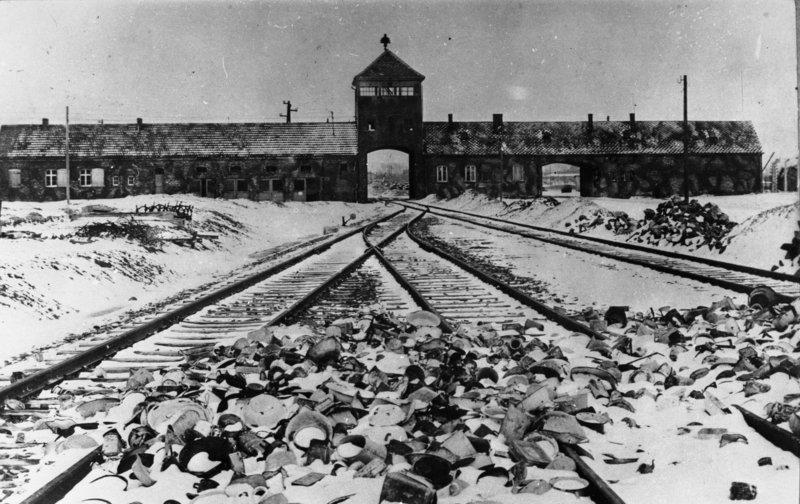
On 16th December 1942, Heinrich Himmler ordered the deportation of the Roma to a concentration camp. The regulation, dated 29th January 1943, to implement this order specified that the deportation destination was to be the Zigeunerlager (i.e. gypsy camp) in KL Auschwitz-Birkenau. Roma from Germany, Austria, the Czech Republic and Poland were to be deported there, as well as from France, the Netherlands, Yugoslavia Belgium, the USSR, Lithuania and Hungary – a total of 23,000 people. The living conditions in the camp were terrible – a significant number of prisoners died from disease. Others, including children, died from the criminal experiments carried out by Josef Mengele.
On the night of 2nd August 1944, the Germans began the liquidation of the “gypsy camp” within Auschwitz. 2,897 Roma were murdered in the gas chambers. According to the estimates of the Auschwitz-Birkenau State Museum, over 20,000 Roma men, women and children died in the camp. It is estimated that, during World War II, half of the Roma population died in the German-occupied territories.
Help during the Holocaust – the Story of Alfreda Markowska
She was born on 10th May 1926 near Stanisławów (now Ivano-Frankivsk), the daughter of Jan and Adela Chojnacki. Her family, from the “Polska Roma” group, was murdered by the Germans, in 1941, near Biała Podlaska. Only she survived because, on that day, she had walked around the surrounding villages in search of food.
She reached the town of Rozwadów (now a district of Stalowa Wola), where there were Roma being used as forced labour on the railway. There, she met Jan Markowski, whom she married in 1942. Soon after, the couple was arrested and taken to the Lublin ghetto, then to the ghetto in Łódż and to Bełżec. They managed to escape and again found themselves in Rozwadów.
At that time, transports, destined for the extermination camps of Auschwitz-Birkenau and Bełżec passed through the town. Alfreda rescued children by organising hiding places for them and obtaining false documents. It is difficult to determine the exact number of children she saved – she was illiterate and kept no notes. However, with the help of Alfreda Markowska, the number is estimated to be several dozen Roma and Jewish children.
In 1944–1945, near Legnica and then in Gdańsk, she also helped German children who were lost due to the war. Wither her husband and wagon, she traveled around Poland.
In 1964, due to the law of “voluntary or forced settlement” of Roma, introduced by the Polish authorities, Alfreda Markowska’s family moved to Poznań, where they experienced difficult living conditions. After the death of her husband, she moved to her children in Gorzów Wielkopolski, where she lived until her death in 2021.
In 2006, she was the first Polish Roma woman to be awarded the Commander’s Cross with Star of the Order of Polonia Restituta, by Polish President Lech Kaczyński.
“If a Jewish nation exists today, including many Jews from our country, as well as a number of Poles of Jewish origin who live in Poland today; if there is a Roma nation and a significant part of it, although not the same as in Slovakia and Hungary, lives in Poland, it is because of people like your.”
“People like you deserve respect and admiration. Awards such as these were invented for such people, especially one of our country’s highest decorations, which is the Commander’s Cross with Star”, said Lech Kaczyński during the decoration presentation to Alfreda Markowska.
Her biography is often compared to that of Irena Sendler, the most famous Polish woman to be honoured by the Yad Vashem Institute with the title of Rightous Among the Nations.